How to read a Kakatiya inscription
The Kakatiyas left about a thousand inscriptions on stone pillars, slabs, temple walls and copper plates. This page shows original impressions and photographs of some of them. It explains how a record is built, how to read its date and where to find the edited texts.
What the inscriptions are
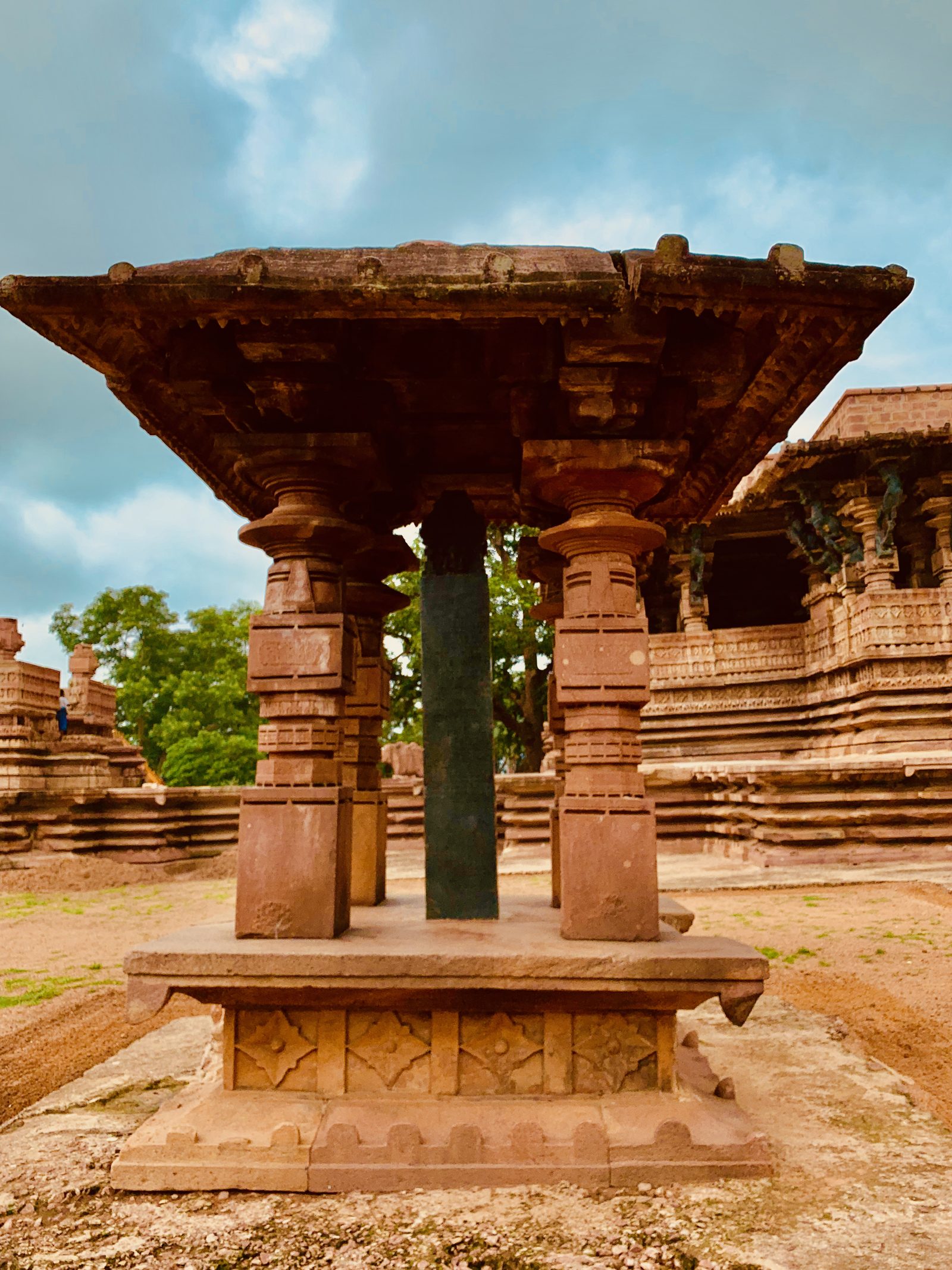
Photograph of the stone
The Ramappa inscription pillar stands in a small pavilion to the north-east of the temple. Recherla Rudra, a general of the Kakatiya king Ganapati, set up this Sanskrit record in 1213.
Photo: Ms Sarah Welch, via Wikimedia Commons · CC0 · This record in the database

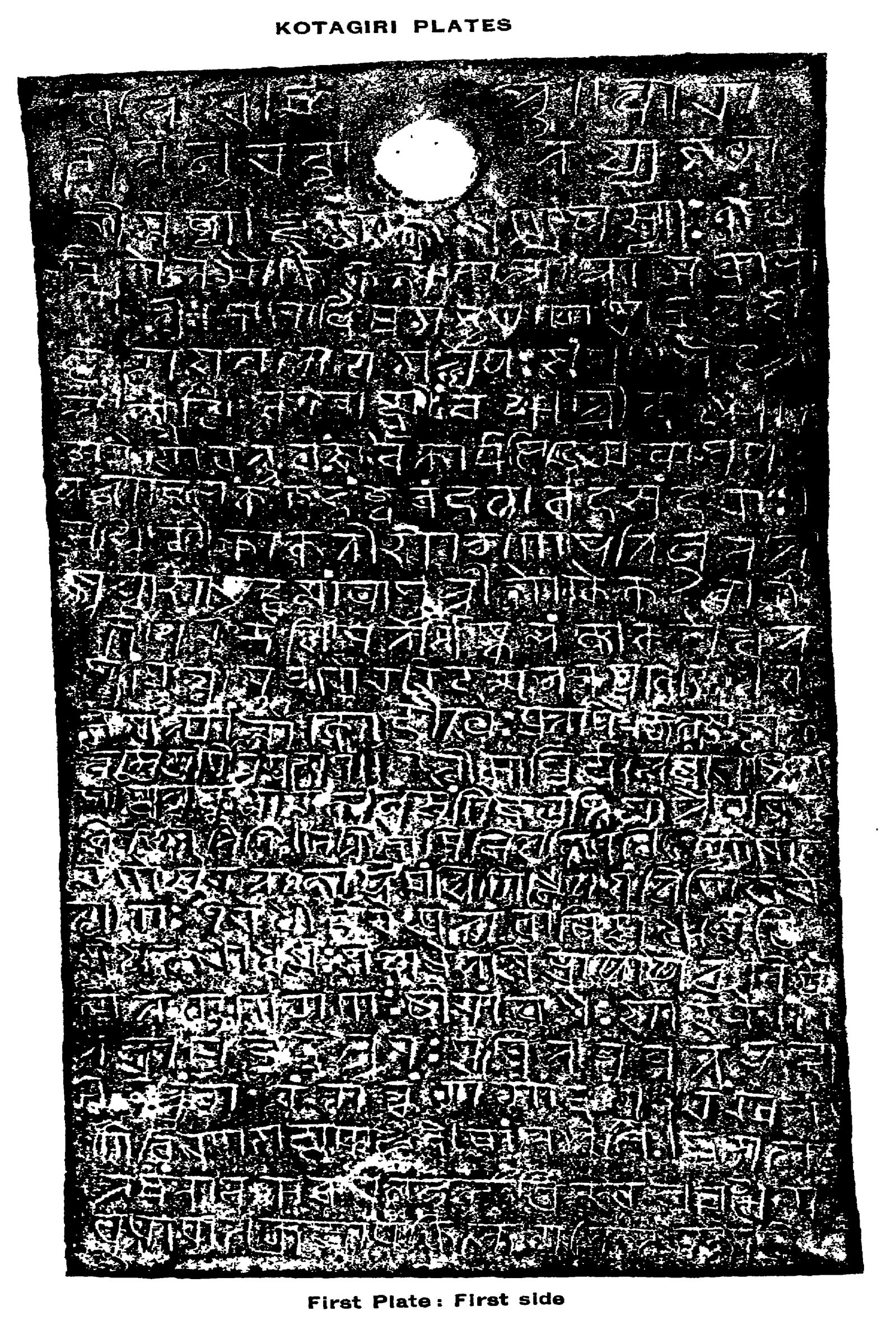
Estampage (ink impression)
The image shows the first side of the first of three copper plates found in a tank at Birkur in Bodhan taluk. The editors say that the letters largely resemble modern Devanagari. The white disc is the hole for the heavy metal hoop that held the three plates together. The book labels the plate "First Plate: First side".
Plate published in S. Hanumant Rao, revised by H. Krishna Sastri, The Kotagiri Plates of the Reign of the Kakatiya Queen Rudramamba, A.D. 1273, Hyderabad Archaeological Series No. 6 (1925). Plate: "Kotagiri Plates. First Plate: First side". · Public domain · This record in the database
The Kakatiya period left two kinds of written records. Most texts were cut into stone pillars, slabs, temple walls and rock faces. A smaller number were engraved on sets of copper plates.
Parabrahma Sastry 1975 (thesis)Parabrahma Sastry 1978 · pvs1975 pp. 5-9 (Sources: copper plate grants and lithic records); pvs1972 pp. 3-7
Telugu writers call a stone inscription a sila-sasanam. A grant on copper plates is a tamra-sasanam.
Parabrahma Sastry 1981 (Telugu)Parabrahma Sastry 1975 (coins) · pvs-sasana-sahityam p. 3 (silasasanalu) and p. 6 (on stone or on copper sheets); pvs-coins-1975 p. 3, title of T. Krishnamurty's article 'Dayagajakesari Khamdavalli Tamra Sasanamu'
P. V. Parabrahma Sastry counted about a dozen copper-plate records that refer directly to the Kakatiya rulers. In his 1975 thesis he wrote that the stone records number more than one thousand. His 1978 book gives the number as nearly one thousand.
Parabrahma Sastry 1975 (thesis)Parabrahma Sastry 1978 · pvs1975 pp. 5-8 (table of 12 copper-plate records) and pp. 8-9; pvs1972 p. 6
Epigraphia Telanganica, published in 2023, compiles 2,396 inscriptions of the whole Telangana region, from the first century to the Nizams. Volume II covers the Kakatiyas up to Ganapati Deva, with 425 inscriptions and 164 variant editions. Volume III covers Rudrama Devi and Prataparudra, with 402 inscriptions and 116 variants.
Epigraphia Telanganica 2023 · Epigraphia Telanganica Vol. I, General Introduction, pp. 7-9
The database on this site holds 869 records extracted from Epigraphia Telanganica. Of these, 553 records match a Kakatiya ruler or a Kakatiya subordinate family. The records of Volume II come from the clean text of the published volume. The true number of Kakatiya records is larger still.
Kings set up some of these records. Rudra Deva set up the inscription at the Thousand Pillar Temple in Anumakonda in 1163. The inscription records the gods that he installed and the village that he gave for their worship.
Epigraphia Telanganica 2023 · ET II pp. 62-71 · Record ii-hanumakonda-3
Women of the royal family set up others. Mailama, the sister of Ganapati Deva, set up the Bayyaram tank inscription. Epigraphia Telanganica notes that women servants of the king also gave cows for perpetual lamps in temples.
Epigraphia Telanganica 2023 · ET I General Introduction pp. 8-9; ET II p. 317 · Record ii-bayyaram-yellendu-taluk
Generals and subordinate chiefs set up many more. The general Recherla Rudra set up the inscribed pillar at the Ramappa temple in Palampet in 1213.
Barnett 1919 · HAS 3 pp. 1-2 · Record ii-palampet-warangal
Merchants and villagers also made gifts. In 1090 the merchant body of Anmakonda gave one mana of oil every day for a lamp, according to the Kazipet pillar. In 1289 a servant named Puvula Mummadi made the gift recorded at Chandupatla.
Epigraphia Telanganica 2023 · ET II Kazipet entries (Corpus II pp. 25-31); ET III pp. 81-82 · Record ii-kazipet-warangal · Record iii-chandupatla
Parabrahma Sastry explains why a donor had a gift written on stone. The donor wanted nobody to disturb the gift. The donor also wanted the temple managers and the herdsman who supplied ghee to keep the service going for generations.
Parabrahma Sastry 1981 (Telugu) · pvs-sasana-sahityam pp. 9-10
Not every building received an inscription. Parabrahma Sastry notes that a rule of the Dharmasastras forbade a donor to praise his own good deeds. For that reason some temples and tanks carry no inscription.
Parabrahma Sastry 1981 (Telugu) · pvs-sasana-sahityam p. 6
Languages and scripts
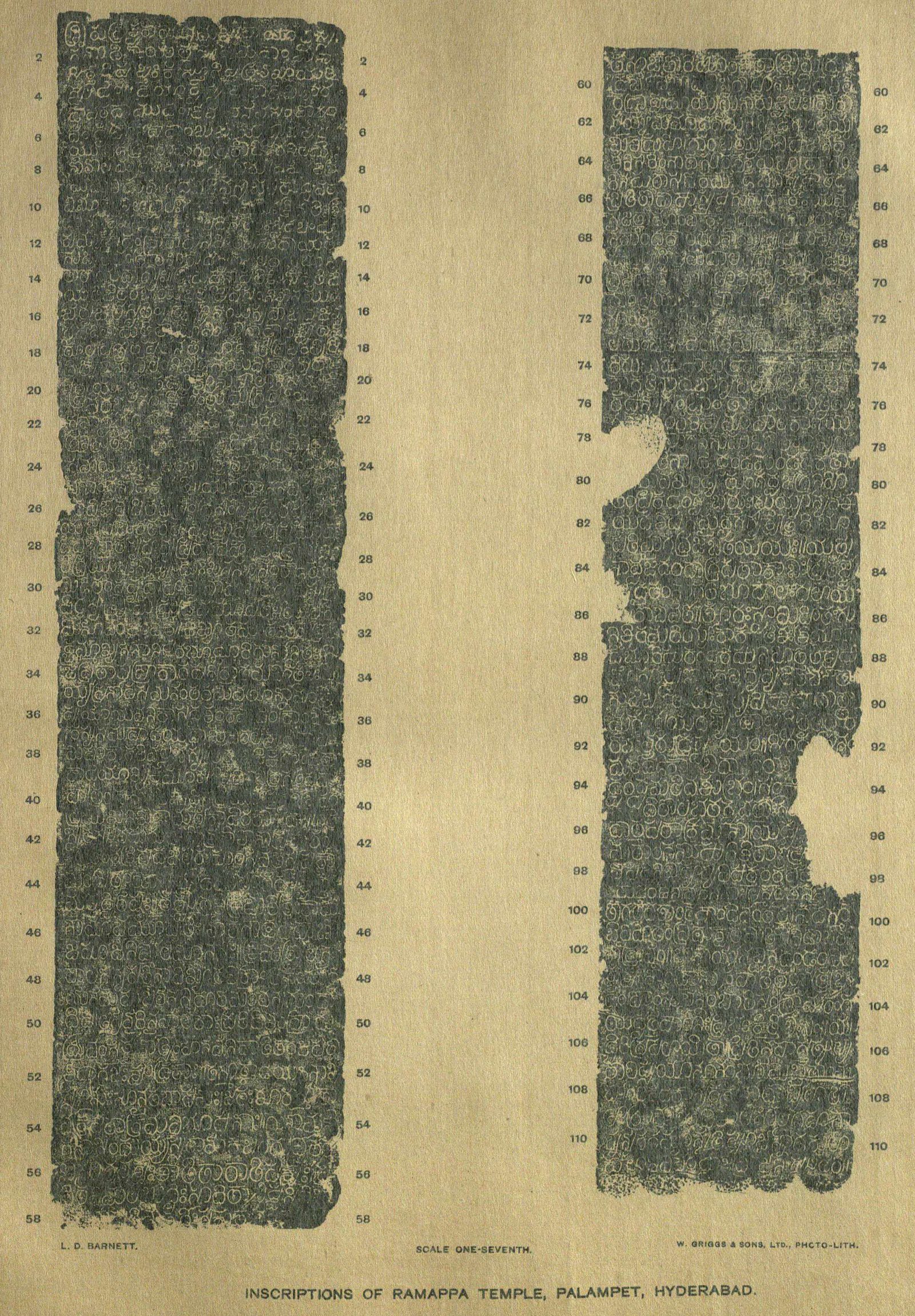
Estampage (ink impression)
This estampage shows lines 1 to 110 of the Sanskrit inscription of Recherla Rudra on a black basalt pillar at the Ramappa temple, Palampet. Barnett describes the letters as fairly good Telugu characters of the type usual in the period. The book prints the plate at one-seventh of the original size, with the caption "Inscriptions of Ramappa Temple, Palampet, Hyderabad".
Estampage published in L. D. Barnett (ed.), Inscriptions at Palampet and Uparpalli, Hyderabad Archaeological Series No. 3 (1919). Photo-lithograph by W. Griggs & Sons. G. Yazdani took the estampages in 1916. Plate: "Inscriptions of Ramappa Temple, Palampet, Hyderabad", scale one-seventh. · Public domain · This record in the database
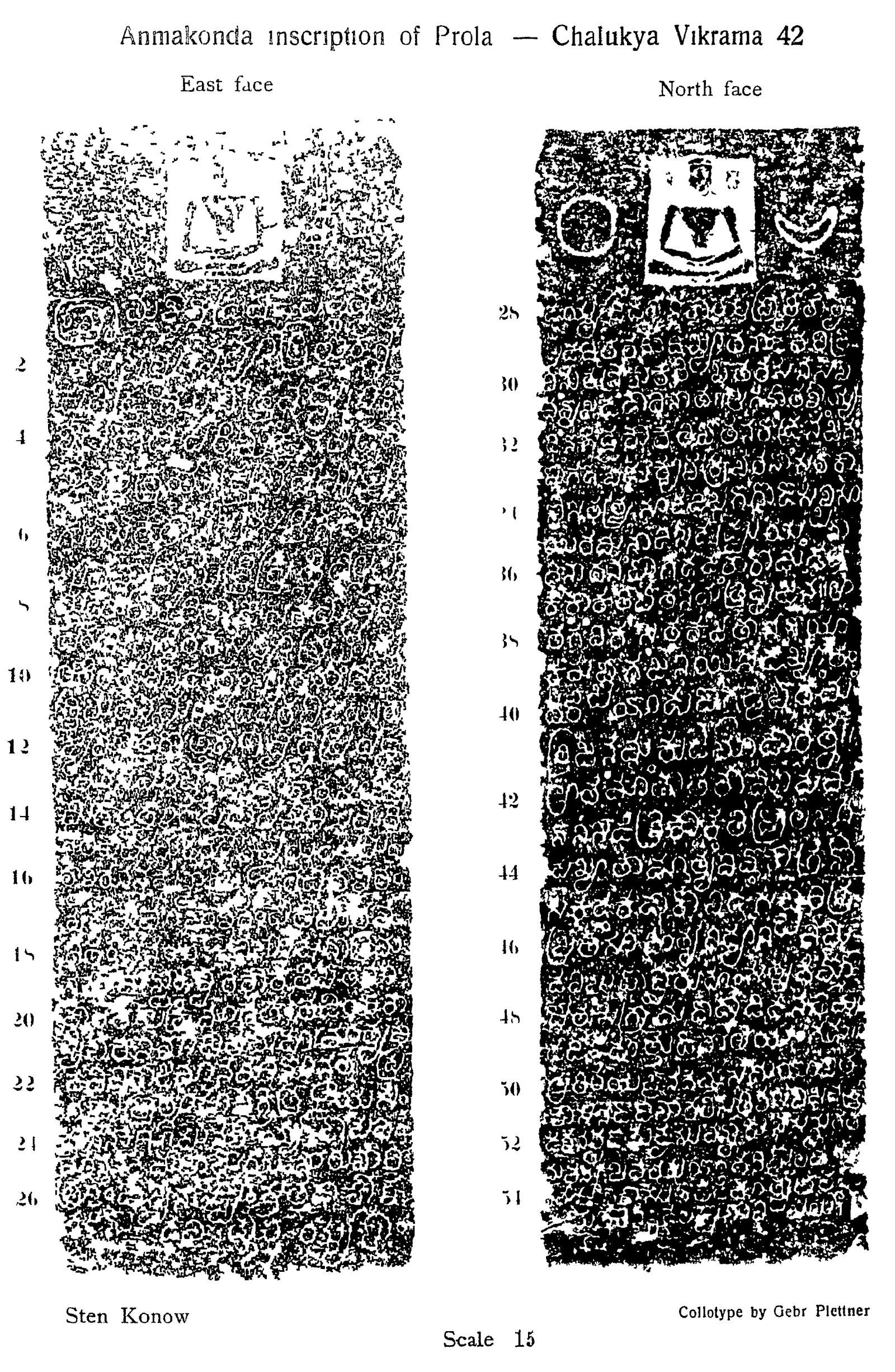
Estampage (ink impression)
This plate shows the east and north faces of the inscribed pillar in front of the Padmakshi temple at Hanamkonda. A seated Jaina ascetic is carved at the top of each face, and the north face also shows the sun and the moon. H. Krishna Sastri describes the letters as bold and clear Kanarese characters of the twelfth century.
Plate published in H. Krishna Sastri, "Anmakonda inscription of Prola: the Chalukya-Vikrama year 42", Epigraphia Indica Vol. IX (1907-08), pp. 256-263. Plate: "Anmakonda inscription of Prola, Chalukya Vikrama 42. East face, North face", signed Sten Konow, collotype by Gebr. Plettner. · Public domain · This record in the database
Photograph of the stone
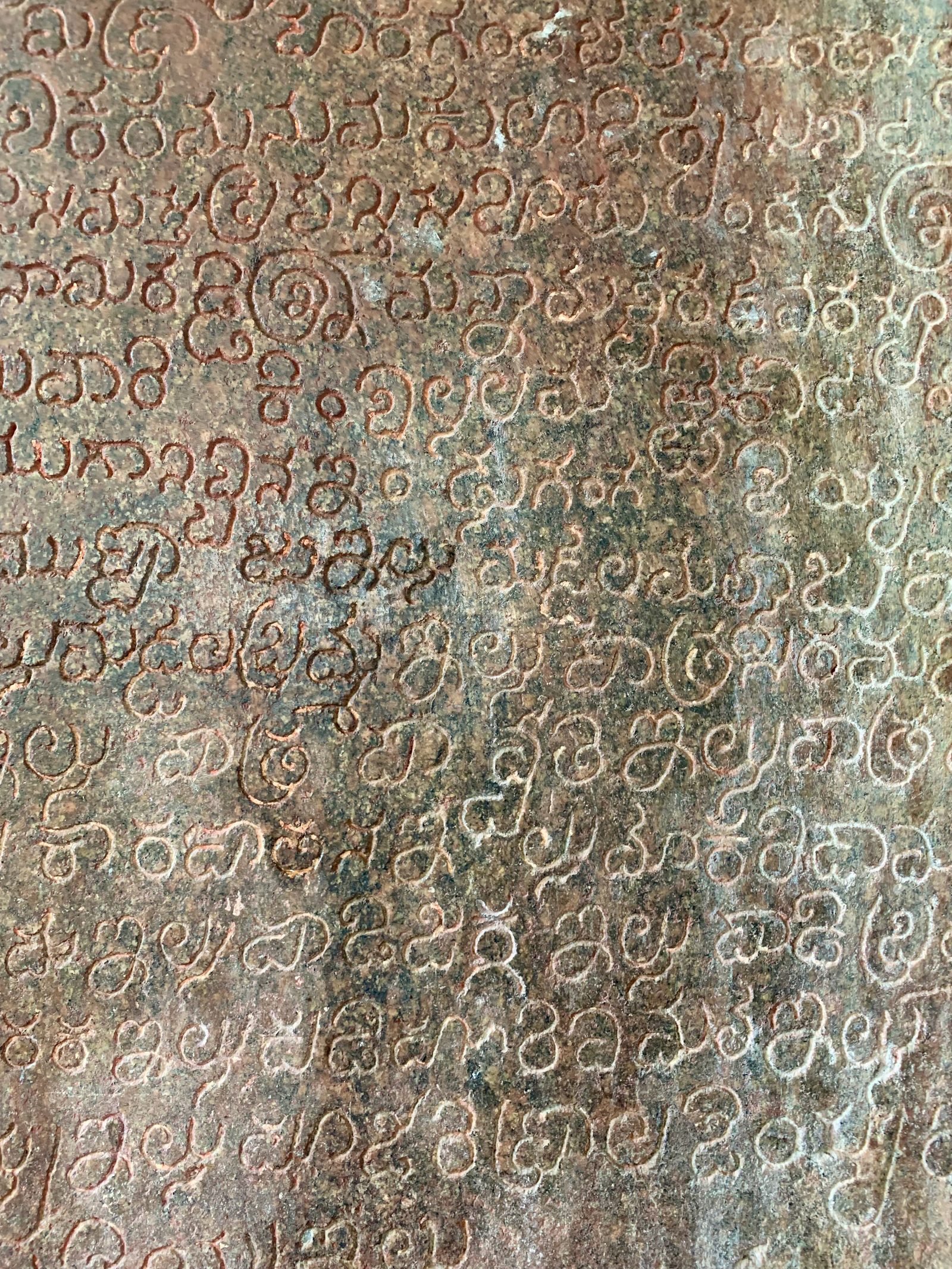
This close view shows the rounded Telugu-Kannada letters of an inscription at the Nameshwara temple in Pillalamarri. Recherla chiefs who served the Kakatiya kings recorded gifts here in 1195 and 1202. The photograph does not show which record this is.

Kakatiya inscriptions use three languages: Sanskrit, Telugu and Kannada. Many records mix them. J. F. Fleet found that the Thousand Pillar inscription opens with eight lines of old Telugu and continues in Sanskrit verse.
Fleet 1882Epigraphia Telanganica 2023 · ET II p. 63, summarising Fleet, IA XI pp. 9-20 · Record ii-hanumakonda-3
The early records of the family often use Kannada. The Guduru pillar of 1124 carries Kannada text on three sides and Telugu verses on the fourth side.
Parabrahma Sastry 1981 (Telugu) · pvs-sasana-sahityam pp. 116-118 · Record i-guduru
Telugu and Kannada once shared one script, which scholars call the Telugu-Kannada script. Epigraphia Telanganica names a record of 660 CE at Amudalapadu as the earliest Telugu inscription in Telangana. That record uses old Telugu-Kannada letters.
Epigraphia Telanganica 2023 · ET I General Introduction p. 8
Parabrahma Sastry writes that the common Telugu-Kannada script had divided into two separate scripts by about 1150. He adds that Kannada inscriptions are rare in the Telugu country after that time.
Parabrahma Sastry 1981 (Telugu) · pvs-sasana-sahityam p. 112
H. Krishna Sastri described the Padmakshi pillar of 1117 as written in bold and clear Kanarese characters of the twelfth century. Kanarese is an older English name for Kannada.
Epigraphia Indica IX · EI IX pp. 257-258 · Record ii-anmakonda
Editors describe the letters of each record. Fleet called the letters of the Thousand Pillar inscription of 1163 old-Canarese, meaning old Kannada. L. D. Barnett called the letters of the Ramappa pillar of 1213 fairly good Telugu characters of the period.
Fleet 1882Barnett 1919Epigraphia Telanganica 2023 · ET II p. 63; HAS 3 p. 1 · Record ii-hanumakonda-3 · Record ii-palampet-warangal
Parabrahma Sastry states that students of epigraphy can easily tell thirteenth-century Telugu letters from the Kannada letters of the same period. He reads the letters on Kakatiya gold coins as Telugu, not Kannada.
Parabrahma Sastry 1975 (coins) · pvs-coins-1975 p. 9
Some copper plates use a third script, Nagari. The 1925 editors of the Kotagiri plates of 1273 wrote that the letters resemble modern Devanagari in large measure. The Karimnagar plates of 1246 write even their Telugu prose in Nagari letters.
Kotagiri plates 1925Epigraphia Telanganica 2023 · HAS 6 p. 1; ET II p. 241 · Record ii-karimnagar-3
The old spelling differs from modern Telugu spelling in several ways. Engravers usually doubled a consonant that follows the letter r. Barnett notes this habit on the Ramappa pillar, and Parabrahma Sastry notes it in Telugu records.
Barnett 1919Parabrahma Sastry 1981 (Telugu) · HAS 3 p. 1; pvs-sasana-sahityam p. 112
Parabrahma Sastry lists Telugu spellings such as udiyince for udayince and varushamu for varshamu. Barnett found hardly any difference between the long and the short vowel i on the Ramappa pillar. The same engraver sometimes wrote b in place of v.
Parabrahma Sastry 1981 (Telugu)Barnett 1919 · pvs-sasana-sahityam p. 112; HAS 3 p. 1
The Kotagiri engraver wrote the vowel ri as ru almost throughout, according to the 1925 editors. Readers of the plates therefore meet spellings such as pruthvi for prithvi.
Kotagiri plates 1925 · HAS 6 p. 1 and text lines 13, 22
Inscriptions also use signs for numbers and units. Parabrahma Sastry shows that a vertical stroke can stand for a gadyana, a gold coin. Barnett explains a sign for the land measure martu in the Uparpalli inscription.
Parabrahma Sastry 1975 (coins)Barnett 1919 · pvs-coins-1975 p. 12; HAS 3 p. 17, note 1 · Record ii-upparapalli
Some poets wrote numbers as words. The poet of the Ramappa pillar gave the Saka year as earth, moon, worlds and arrows. Barnett read these four words as the year 1135.
Barnett 1919 · HAS 3 p. 11, verse 47 · Record ii-palampet-warangal
The pictures on this page show these differences. Compare the rounded Telugu letters of the Ramappa pillar, the Kannada letters of the Padmakshi pillar and the Nagari letters of the Kotagiri plates.
The parts of a typical record
Photograph of the stone
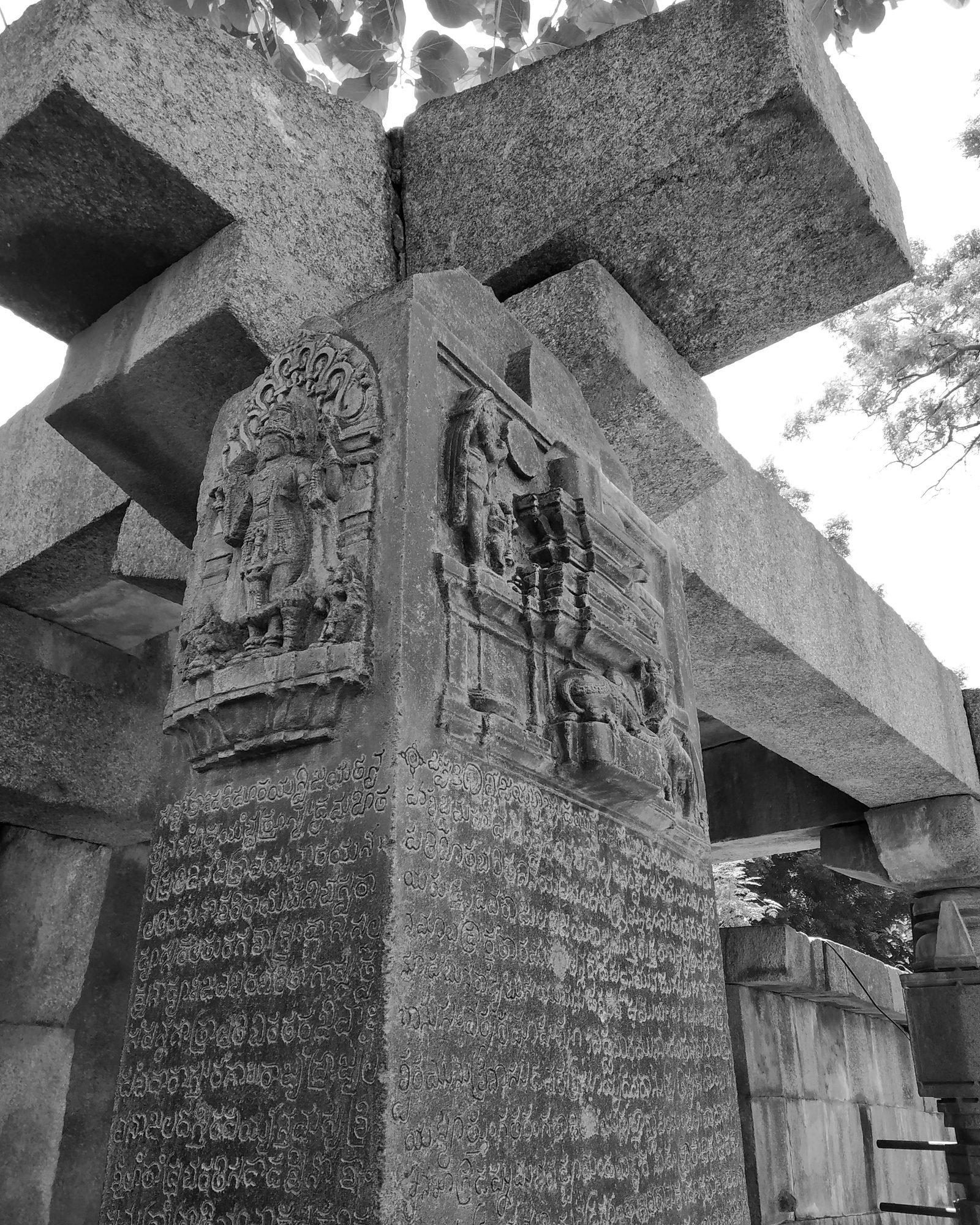
The inscription of the Kakatiya king Rudradeva stands at the Thousand Pillar Temple in Hanamkonda. The record is dated Saka 1084, which is 19 January 1163. Carved panels of gods sit above the text on each face.
Photo: Torchtelangana, via Wikimedia Commons · CC BY-SA 4.0 · This record in the database

Photograph of the stone
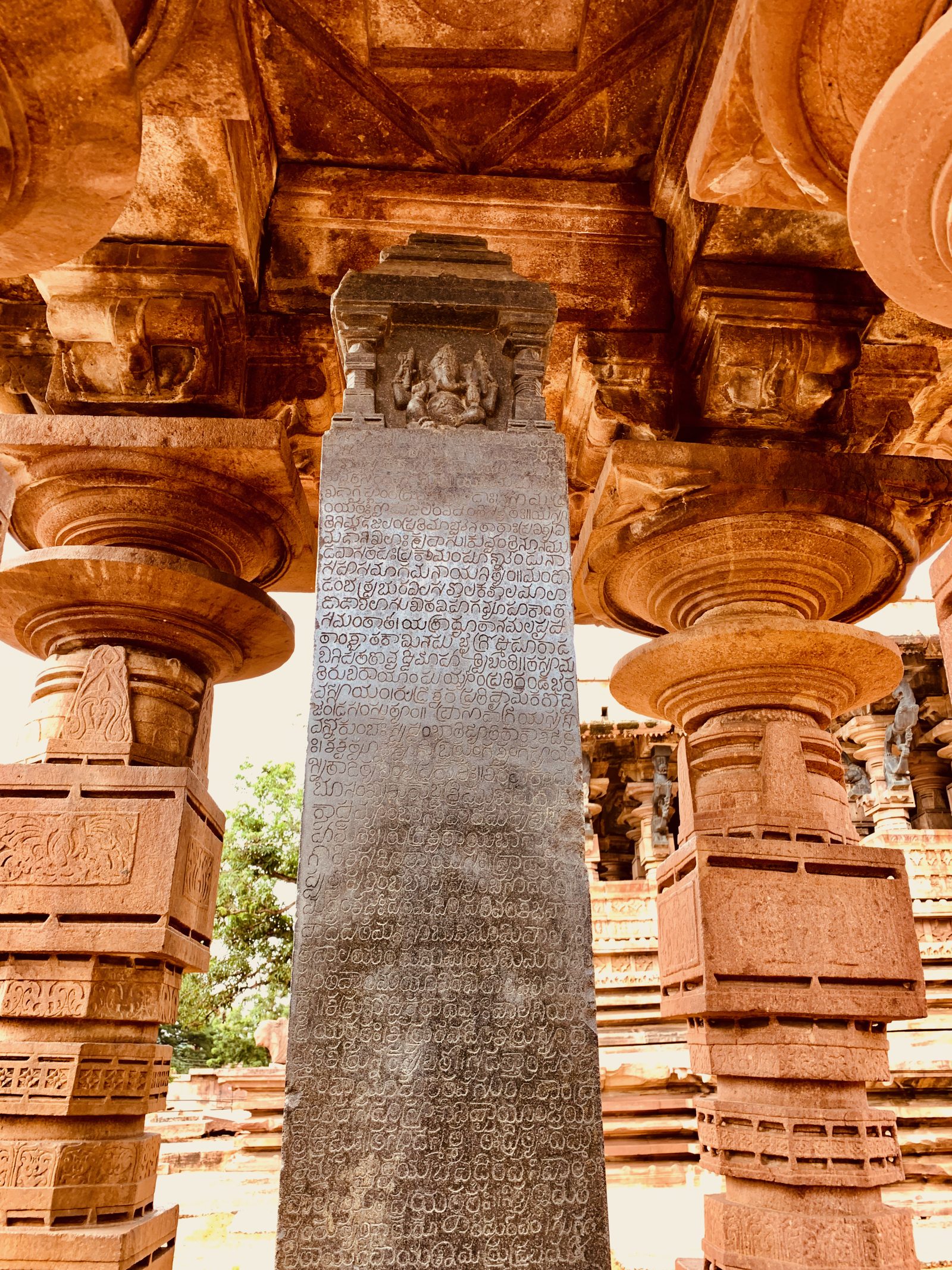
Each of the four faces of the Ramappa pillar has a carved panel at the top. This face shows Ganesa. Barnett (1919) lists a linga, a cow and calf, and the sun and moon on the other faces.
Photo: Ms Sarah Welch, via Wikimedia Commons · CC0 · This record in the database

Photograph of the stone
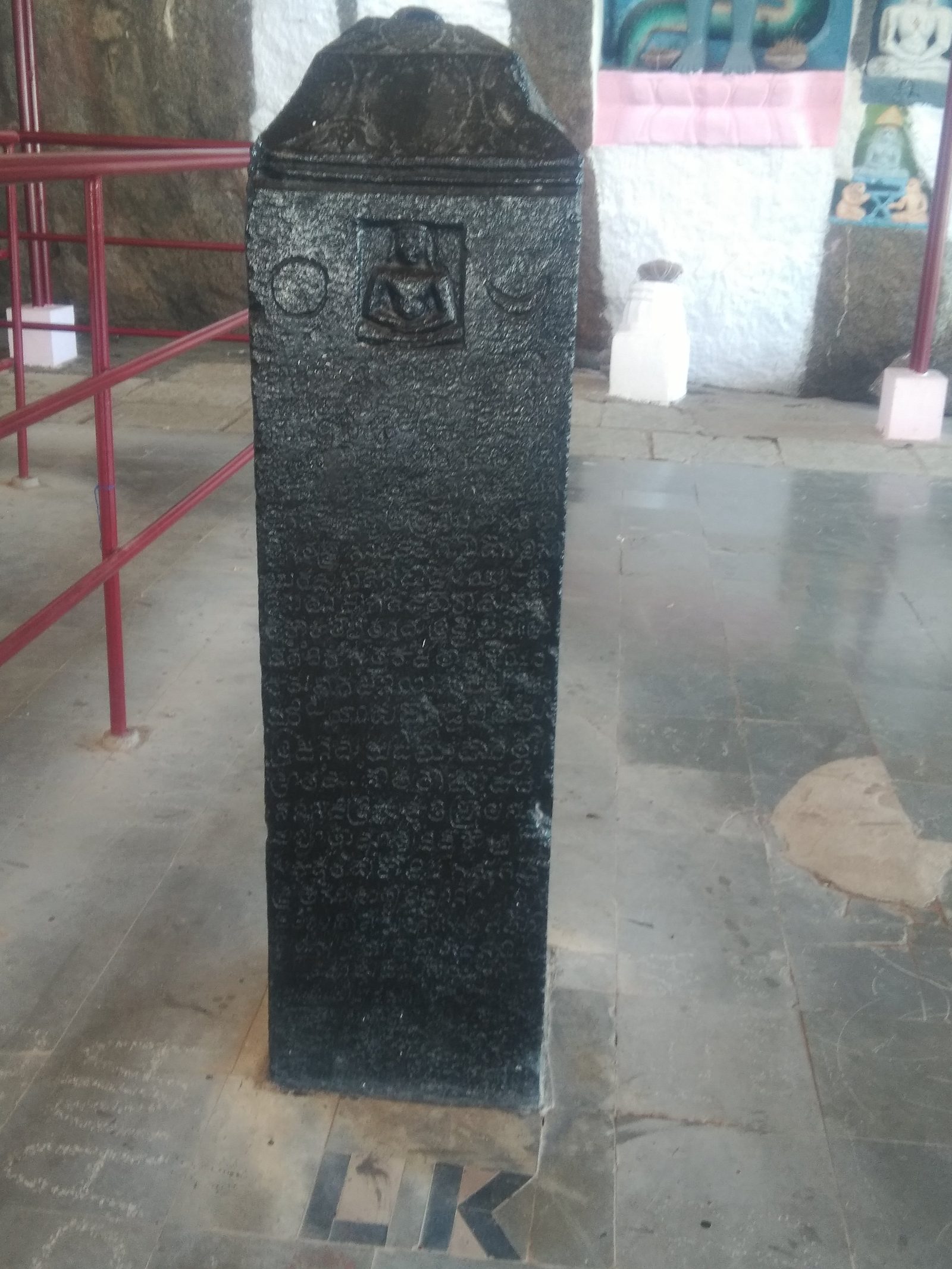
The north face of the pillar at the Padmakshi temple shows a seated Jaina teacher between the sun and the moon. Mailama, the wife of a minister of Prola II, set up this Kannada record in 1117.
Photo: Pakideadithya, via Wikimedia Commons · CC BY-SA 4.0 · This record in the database

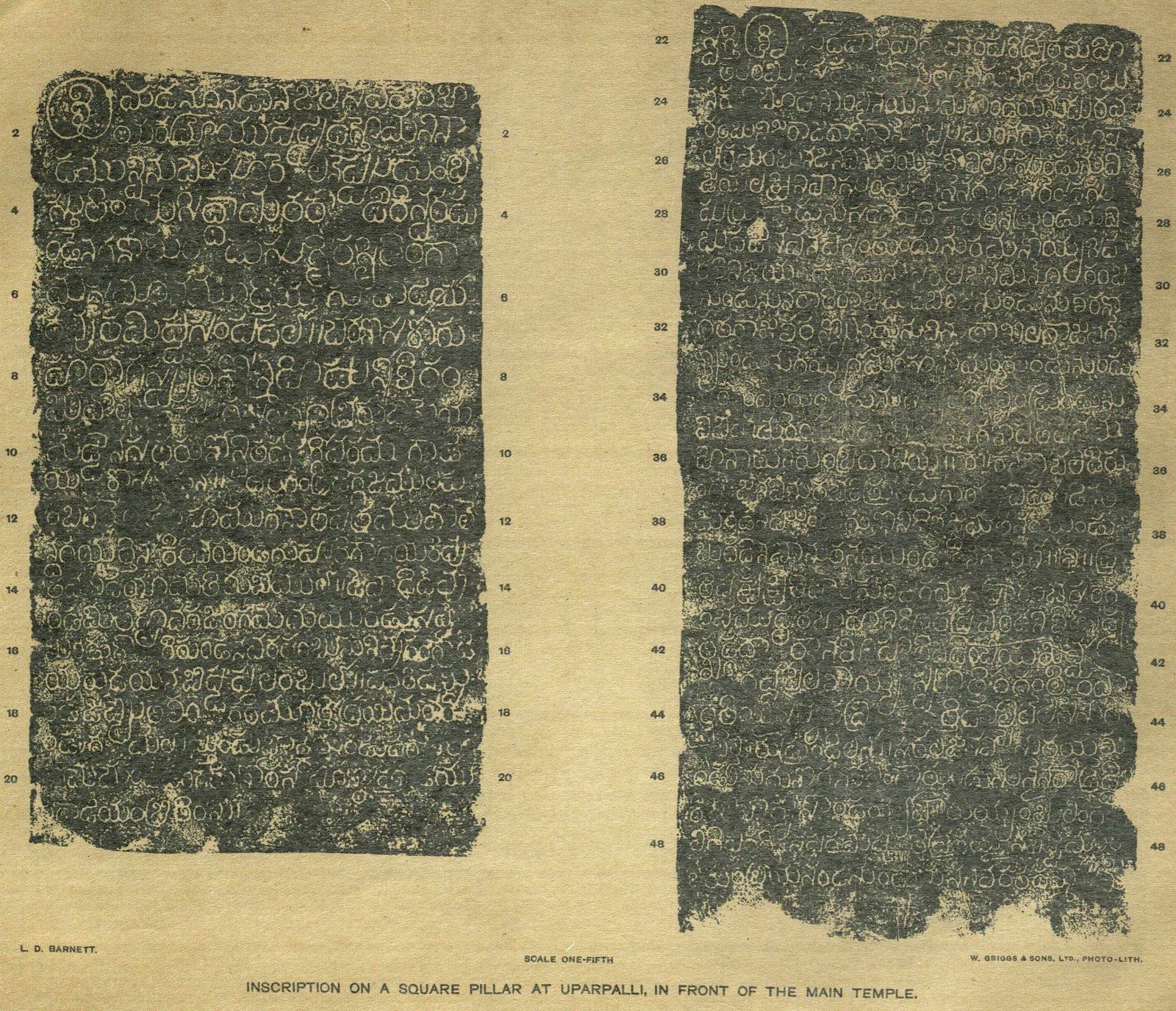
Estampage (ink impression)
This estampage shows the opening lines of the Telugu inscription on a square pillar in front of the main temple at Uparpalli. The record belongs to the reign of Ganapatideva and praises Kataya, a minister of Recherla Rudra. Barnett calls the script "Telugu of the period, of a regular and well-shaped type". The plate is one-fifth of the original size.
Estampage published in L. D. Barnett (ed.), Inscriptions at Palampet and Uparpalli, Hyderabad Archaeological Series No. 3 (1919). Photo-lithograph by W. Griggs & Sons. G. Yazdani took the estampages in 1916. Plate: "Inscription on a square pillar at Uparpalli, in front of the main temple", scale one-fifth. · Public domain · This record in the database
Most Kakatiya records follow a fixed order. A short record may leave parts out. The Chandupatla stone of 1289 has no invocation and no curse verses.
Epigraphia Telanganica 2023 · ET III p. 81 · Record iii-chandupatla
Parabrahma Sastry notes that the invocation and the curse verses are customary in all inscriptions except epitaphs and similar records.
Epigraphia Telanganica 2023 · ET III p. 81 · Record iii-chandupatla
1. The invocation opens the record. The Thousand Pillar inscription begins with Om and Hail. It then praises Vishnu as the Boar, the god Ganesa and the goddess Sarasvati.
Fleet 1882Epigraphia Telanganica 2023 · ET II p. 66, lines 1-16 · Record ii-hanumakonda-3
The Ramappa pillar begins with Sri Rudresvaraya namah, which means obeisance to the blessed Rudresvara. The Bayyaram tank inscription begins with Sri Mahadevaya namah. The Kotagiri plates begin with Svasti, which means hail.
Barnett 1919Epigraphia Telanganica 2023Kotagiri plates 1925 · HAS 3 p. 2, text line 1; ET II p. 317; HAS 6 p. 3, text line 1 · Record ii-palampet-warangal · Record ii-bayyaram-yellendu-taluk
2. The praise of the king and the family tree come next. Scholars call this part the prasasti. Parabrahma Sastry writes that kings had their own greatness written into their records in the form of prasasti.
Parabrahma Sastry 1981 (Telugu) · pvs-sasana-sahityam p. 6
In the Thousand Pillar inscription, lines 20 to 163 give the genealogy and the praise of Rudra Deva. The Kotagiri plates praise Queen Rudramamba in one verse. The plates then praise the family of the donor in ten verses.
Fleet 1882Kotagiri plates 1925Epigraphia Telanganica 2023 · ET II p. 63; HAS 6 p. 2, verses 3-13 · Record ii-hanumakonda-3
3. The date follows. The Ramappa pillar dates its gift to Saka 1135, the cycle year Srimukha, the eighth day of the bright fortnight of Chaitra, a Sunday. The section on dates below explains each element.
Barnett 1919 · HAS 3 p. 2 · Record ii-palampet-warangal
4. The record names the donor, often with the donor's family and overlord. Parabrahma Sastry states that no inscription lacks the name of its donor. The Kotagiri plates name Sura of the Viryala family, a subordinate of Queen Rudramamba.
Parabrahma Sastry 1981 (Telugu)Kotagiri plates 1925 · pvs-sasana-sahityam p. 118; HAS 6 p. 2
5. The gift is the core of the record. Rudra Deva gave the large village of Matticheruvala for the worship of Siva, Vishnu and the Sun at the Thousand Pillar Temple.
Fleet 1882Epigraphia Telanganica 2023 · ET II p. 65 and p. 70 · Record ii-hanumakonda-3
Gifts for lamps are common. In 1079 King Beta gave land for a perpetual lamp at Hanamkonda, and the record fixes twelve manikas of ghee for the lamp. In 1245 a Viryala chief gave thirty cows for a lamp in Warangal. A cowherd named Dhammaya took the cows and agreed to supply the ghee.
Epigraphia Telanganica 2023 · ET II p. 36; ET II p. 232 · Record ii-hanumakonda-warangal · Record ii-warangal-3
Some gifts were incomes or coins. At Terala in 1292 a donor gave the tax income of a village to the god Siddhesvara. In the Uttaresvara grant Prataparudra gave 100 nishkas, which were gold coins, to the scholar Viddanacharya.
Parabrahma Sastry 1975 (coins) · pvs-coins-1975 p. 11 and Appendix p. 21 · Record iii-uttaresvara-grant
6. The record states the purpose. Many gifts paid for worship, lamps and offerings in a temple. At Bhutpur in 1259 the chief Malyala Gunda built a tank and named the tank after his mother.
Epigraphia Telanganica 2023 · ET II p. 292
Many gifts were made for the merit of another person. At Chandupatla, Puvula Mummadi gave land so that Rudrama Devi and the general Mallikarjuna Nayaka might reach the world of Siva.
Epigraphia Telanganica 2023 · ET III pp. 81-82 · Record iii-chandupatla
7. Land grants describe the boundaries of the land. The Mangallu copper plates of about 956 name a landmark in each of the eight directions around the village. The Kotagiri plates describe their village as marked with four boundaries.
Epigraphia Telanganica 2023Kotagiri plates 1925 · ET II p. 19; HAS 6 p. 9, verse 16 · Record ii-mangallu-2
Some records name witnesses. The Karimnagar copper plates of 1246 settle a dispute over a canal. The plates record that elders of three villages gave evidence, and they list the witnesses in Telugu.
Epigraphia Telanganica 2023 · ET II pp. 241-242 · Record ii-karimnagar-3
8. Verses of blessing and curse come near the end. The Ramappa pillar says that a person who takes away granted land is born as a worm in dung for sixty thousand years.
Barnett 1919 · HAS 3 p. 11, verse 51 · Record ii-palampet-warangal
The same verse appears in the Kondiparti inscription of 1203 and in the Kotagiri plates. Another common verse says that protecting a gift earns more merit than giving it. Editors often print these lines only as the usual imprecatory verses.
Epigraphia Telanganica 2023Kotagiri plates 1925 · ET II p. 127, verses 45-46; HAS 6 p. 9, verses 18-25; ET II p. 36 · Record ii-kondiparti-warangal
9. Some records end with the names of the poet and the engraver. The ascetic Achintendra, a disciple of Advayamrita, composed the verses of the Thousand Pillar inscription.
Epigraphia Telanganica 2023Fleet 1882 · ET II p. 66, line 16, and p. 70 · Record ii-hanumakonda-3
At Bhutpur in 1259 the scholar Isvara Suri received land for composing the Sanskrit text. A man named Oddaya engraved the record. The Guduru pillar of 1124 names its engraver, the sutradhari Kommoju.
Epigraphia Telanganica 2023Parabrahma Sastry 1981 (Telugu) · ET II p. 292; pvs-sasana-sahityam p. 118 · Record i-guduru
Engravers sometimes made mistakes. Parabrahma Sastry reports that three of the twenty-four lines at Chandupatla are illegible because of the engraver's negligence.
Epigraphia Telanganica 2023 · ET III p. 81 · Record iii-chandupatla
Many stones also carry emblems above the text. The Ramappa pillar shows a linga, a cow and calf, the sun and moon, and Ganesa, one on each face. The Kotagiri plates hang on a metal hoop that bears a boar, the Kakatiya emblem.
Barnett 1919Kotagiri plates 1925 · HAS 3 p. 1; HAS 6 p. 1
How to read a date
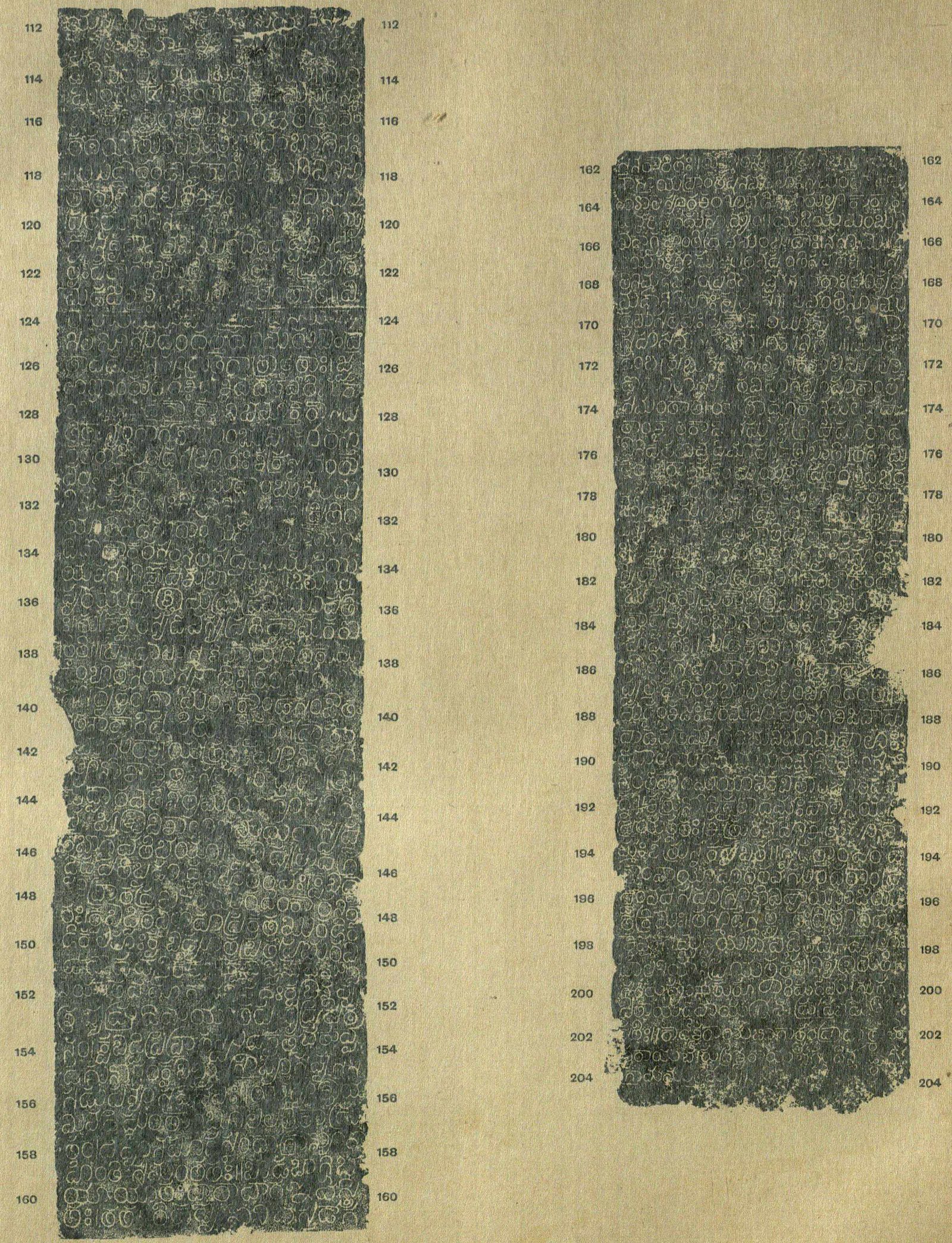
Estampage (ink impression)
This estampage continues the Ramappa pillar inscription from line 112 to line 204. Lines 183 and 184 in the right-hand column give the date of the grant. Barnett reads Saka 1135, the year Srimukha, Chaitra bright eighth day, Sunday, and equates it with 31 March 1213.
Estampage published in L. D. Barnett (ed.), Inscriptions at Palampet and Uparpalli, Hyderabad Archaeological Series No. 3 (1919). Photo-lithograph by W. Griggs & Sons. G. Yazdani took the estampages in 1916. Second page of the plate "Inscriptions of Ramappa Temple, Palampet, Hyderabad" (unnumbered continuation). · Public domain · This record in the database
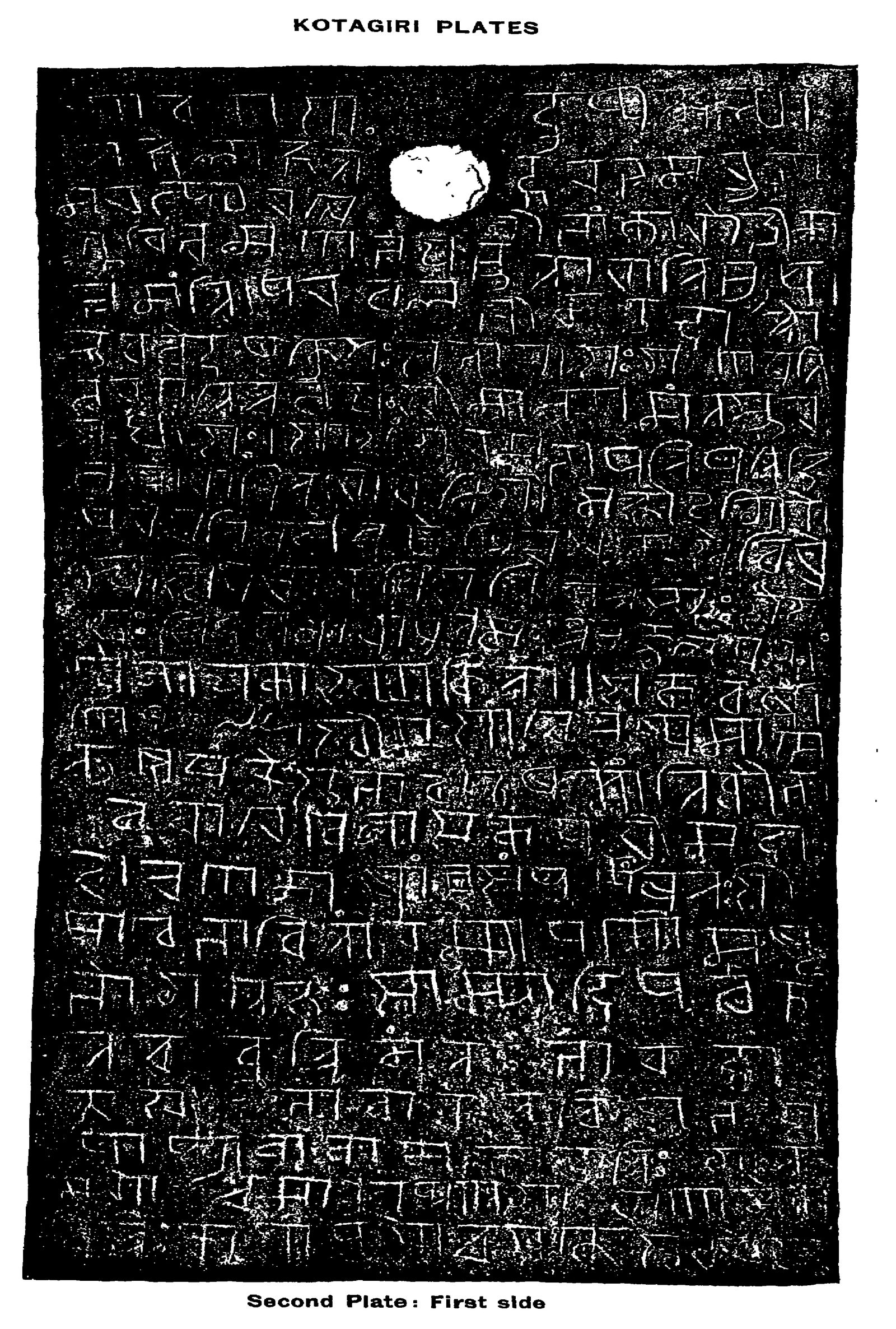
Estampage (ink impression)
This side of the second plate begins at line 53 and includes lines 65 to 68, which give the date. The editors read Saka 1195, the year Srimukha, Pushya, dark fortnight, sixth day, Sunday. They equate it with 31 December 1273. The book labels the plate "Second Plate: First side".
Plate published in S. Hanumant Rao, revised by H. Krishna Sastri, The Kotagiri Plates of the Reign of the Kakatiya Queen Rudramamba, A.D. 1273, Hyderabad Archaeological Series No. 6 (1925). Plate: "Kotagiri Plates. Second Plate: First side". · Public domain · This record in the database
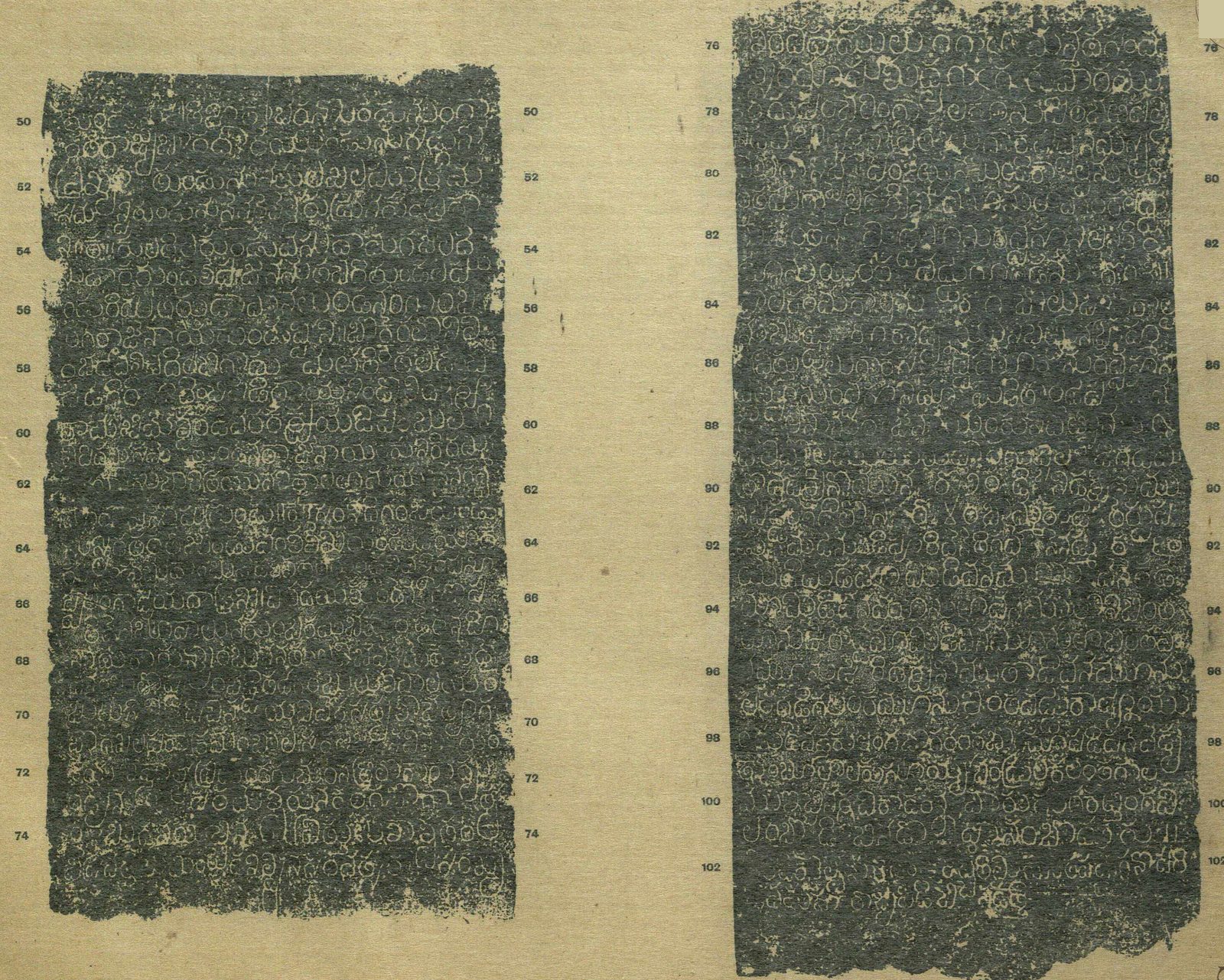
Estampage (ink impression)
This estampage shows lines 50 to 102 of the Uparpalli pillar inscription. Lines 76 to 78 give the date as Saka 1157, the year Manmatha, Magha bright fifteenth day, Thursday. Barnett equates the date with 24 January 1236. The book prints this plate sideways, and the image here is turned upright.
Estampage published in L. D. Barnett (ed.), Inscriptions at Palampet and Uparpalli, Hyderabad Archaeological Series No. 3 (1919). Photo-lithograph by W. Griggs & Sons. G. Yazdani took the estampages in 1916. Second page of the plate "Inscription on a square pillar at Uparpalli, in front of the main temple" (unnumbered continuation, printed sideways). · Public domain · This record in the database
Most Kakatiya records count years in the Saka era. Some early records count years in the Chalukya-Vikrama era instead. F. Kielhorn equates year 42 of that era with Saka 1039 for the Padmakshi pillar of 1117.
Epigraphia Telanganica 2023Epigraphia Indica IX · EI IX p. 259 (Kielhorn's note on the date) · Record ii-anmakonda
A Saka year began in spring. Robert Sewell's examples place the start of the year in March. He also warns that a bare Saka number can cover parts of two CE years.
Sewell 1932 · Sewell 1932, Notes (ii), front matter
To convert a Saka year, add 78 for a date between spring and December. Add 79 for a date in January, February or early March. The examples below show both cases.
Indian records count a year either as current or as expired. The two counts differ by one year. Sewell gives this warning, and Kielhorn marks the Padmakshi year as Saka 1039 expired.
Sewell 1932Epigraphia Indica IX · Sewell 1932, Notes (ii); EI IX p. 259
Most records also name the year in a cycle of sixty years. Each year of the cycle has a name, such as Srimukha, Pingala, Chitrabhanu or Virodhi. The name repeats every sixty years.
The cycle name lets a reader test the Saka number. The Ramappa gift of Saka 1135 and the Kotagiri grant of Saka 1195 both fall in a Srimukha year, exactly sixty years apart.
Barnett 1919Kotagiri plates 1925 · HAS 3 p. 2; HAS 6 p. 9 · Record ii-palampet-warangal
The Thousand Pillar year, Saka 1084, is a Chitrabhanu year. Kielhorn notes that the expired Saka year 1144 was also Chitrabhanu, and 1144 lies exactly sixty years later.
Fleet 1882Epigraphia Indica IIIEpigraphia Telanganica 2023 · ET II p. 181 (Kielhorn on the Bahal inscription, EI III) · Record ii-hanumakonda-3 · Record ii-bahal-inscription
The cycle name once corrected a famous misreading. Earlier editors read the Thousand Pillar year as Saka 1054 and Saka 1064. The scholar Rice saw that neither year fits Chitrabhanu, but he wrongly placed the record in the ninth century. Fleet then read the year as Saka 1084.
Fleet 1882Epigraphia Telanganica 2023 · ET II pp. 62-63 · Record ii-hanumakonda-3
Next the record gives the lunar month, such as Chaitra, Magha or Pushya. Each month has a bright fortnight, called sukla or suddha, and a dark fortnight, called bahula or krishna.
Barnett 1919Kotagiri plates 1925Parabrahma Sastry 1975 (coins) · HAS 3 pp. 2, 16; HAS 6 p. 9; pvs-coins-1975 p. 7
The tithi is the numbered lunar day within the fortnight. The Ramappa date falls on the eighth tithi of the bright fortnight of Chaitra. Barnett reports that this tithi ended about ten hours after sunrise on that Sunday.
Barnett 1919 · HAS 3 p. 2
The weekday comes last. Bhanuvara means Sunday in the Kotagiri plates. Guruvaramu means Thursday at Uparpalli. Vaddavara means Saturday in the Thousand Pillar inscription.
Kotagiri plates 1925Barnett 1919Epigraphia Telanganica 2023 · HAS 6 p. 9; HAS 3 p. 16; ET II p. 70
Some records add an event of the sky, such as a solar eclipse or the Uttarayana-samkranti. The Padmakshi pillar was set up on the day of Uttarayana-samkranti, which Kielhorn places on Monday, 24 December 1117.
Epigraphia Indica IXEpigraphia Telanganica 2023 · EI IX p. 259; ET II p. 36 · Record ii-anmakonda
Editors calculate the tithi and then test the weekday. Barnett reports that the Uparpalli tithi was current at sunrise on Thursday, 24 January 1236. Thursday is also the weekday in the record.
Barnett 1919 · HAS 3 p. 16 · Record ii-upparapalli
When the weekday fails, editors say so. The Meruru record of 1197 names a Monday, but its editors note that the date fell on a Wednesday.
Epigraphia Telanganica 2023 · ET II p. 103 · Record ii-meruru
This site uses the weekday to choose the date of the Chandupatla record. The record gives Saka 1211, Virodhi, the twelfth tithi of the bright fortnight of Margasira, and a Friday.
Epigraphia Telanganica 2023 · ET III p. 81 · Record iii-chandupatla
Parabrahma Sastry equates the Chandupatla date with Friday, 25 November 1289. A modern biography gives 27 November 1289 instead. A calendar check shows that 27 November 1289 was a Sunday, so the site keeps 25 November.
Epigraphia Telanganica 2023Punjala 2016 · ET III p. 82; punjala2016 annexure; weekday computed from the Julian day number · Record iii-chandupatla
Worked example 1: the Thousand Pillar Temple inscription. The record gives the date as Saka 1084, Chitrabhanu, Magha, bright fortnight, thirteenth tithi, Vaddavara.
Fleet 1882Epigraphia Telanganica 2023 · ET II p. 66 and p. 70 · Record ii-hanumakonda-3
| Element | The record says | Reading |
|---|---|---|
| Era and year | Saka 1084 | The year number in the Saka era |
| Cycle year | Chitrabhanu | A name in the sixty-year cycle |
| Month | Magha | A lunar month that falls in January or February |
| Fortnight | Bright (sukla) | The half of the month when the moon grows |
| Tithi | 13 | The thirteenth lunar day of the bright fortnight |
| Weekday | Vaddavara | Saturday |
| CE year | 1084 + 79 | 1163, because Magha falls before the new Saka year begins in spring |
| Result | Saturday, 19 January 1163 |
Sources: Fleet 1882Epigraphia Telanganica 2023Sewell 1932 · ET II p. 62 (ARIE 1957-58) and p. 70 (Inscriptions of Warangal District)
The Annual Report on Indian Epigraphy for 1957-58 and Inscriptions of Warangal District both equate this date with 19 January 1163. A calendar check confirms that 19 January 1163 was a Saturday.
Epigraphia Telanganica 2023 · ET II p. 62 and p. 70; weekday computed from the Julian day number · Record ii-hanumakonda-3
Worked example 2: the Kotagiri copper plates. Verse 15 gives the year Srimukha, the month Pushya, the dark fortnight, the sixth tithi and Sunday. Line 65 gives the Saka year 1195.
Kotagiri plates 1925 · HAS 6 p. 5, text lines 61-68, and p. 9
The second Kotagiri plate on this page carries the date in lines 65 to 68.
Kotagiri plates 1925 · HAS 6 plate, second plate first side
| Element | The record says | Reading |
|---|---|---|
| Era and year | Saka 1195 | The year number in the Saka era |
| Cycle year | Srimukha | The same cycle name as the Ramappa year, Saka 1135 |
| Month | Pushya | A lunar month that falls in December or January |
| Fortnight | Dark (krishna) | The half of the month when the moon wanes |
| Tithi | 6 (shashthi) | The sixth lunar day of the dark fortnight |
| Weekday | Bhanuvara | Sunday |
| CE year | 1195 + 78 | 1273, because this Pushya falls in December |
| Result | Sunday, 31 December 1273 |
Sources: Kotagiri plates 1925 · HAS 6 p. 2 (date from Swamikannu Pillai's Indian Ephemeris)
The 1925 editors took the equation from the Indian Ephemeris of L. D. Swamikannu Pillai. They give the result as Sunday, 31 December 1273.
Kotagiri plates 1925 · HAS 6 p. 2
Worked example 3 is shorter. The Ramappa pillar gives Saka 1135, Srimukha, Chaitra bright eight, Sunday. Barnett fixes the day as Sunday, 31 March 1213. The date falls after the spring start of the Saka year, so 1135 plus 78 gives 1213.
Barnett 1919 · HAS 3 p. 2 · Record ii-palampet-warangal
The second Ramappa estampage on this page shows the date in lines 183 and 184.
Barnett 1919 · HAS 3 p. 2 and plate · Record ii-palampet-warangal
Common words and units
Nanda-divi means a perpetual lamp in a temple. Records also call it nanda-dipa or akhanda-dipa. Donors paid for the lamp with land, cows, ghee or oil.
Epigraphia Telanganica 2023 · ET II p. 36, p. 57, p. 84, p. 232 · Record ii-hanumakonda-warangal · Record ii-warangal-3 · Record ii-itikala-gazvel-taluk-medak
Parabrahma Sastry notes that some records allow one manika of ghee for a perpetual lamp. Other records allow only three solas of ghee.
Parabrahma Sastry 1975 (coins) · pvs-coins-1975 p. 19
A gadyana was a gold coin. Parabrahma Sastry shows that the words gadya, mada and the Sanskrit nishka all name the same coin. Kakatiya records call it the kesari-gadyana or kesari-mada.
Parabrahma Sastry 1975 (coins) · pvs-coins-1975 pp. 11-12, 18
Ten rukas made one mada. The words adduga, padika, paraka and visa mean one half, one quarter, one eighth and one sixteenth of a standard coin.
Parabrahma Sastry 1975 (coins) · pvs-coins-1975 pp. 12, 14
Parabrahma Sastry warns that the exact value of these coins is unknown. He writes that any conclusion about their values cannot be better than a conjecture.
Parabrahma Sastry 1975 (coins) · pvs-coins-1975 p. 14
The tumu and the putti were the basic measures of grain. Twenty tumus made one putti. Records used the same words to measure land.
Parabrahma Sastry 1975 (coins) · pvs-coins-1975 p. 19
The royal standards were the kesari-tumu and the kesari-putti. Parabrahma Sastry finds no way to convert these units into modern measures.
Parabrahma Sastry 1975 (coins) · pvs-coins-1975 pp. 18-19
The martu, also written marturu, was a measure of land. Barnett equates it with the Sanskrit nivartana. King Beta gave ten marturus of wet land in 1079.
Barnett 1919Epigraphia Telanganica 2023 · HAS 3 p. 17, note 1; ET II p. 36 · Record ii-hanumakonda-warangal
A vritti was a share or holding in a granted village. The Kotagiri village was divided into twenty shares among sixteen holders, and one holder was the god Purushottama.
Kotagiri plates 1925 · HAS 6 pp. 2-3, 9
An agrahara was a village granted to Brahmans. Sura of the Viryala family founded such a village at Vejjalapuri, according to the Kotagiri plates.
Kotagiri plates 1925 · HAS 6 p. 9, verse 17
A manya was land held free of tax. The editor of the Salakalavidu record of 1317 explains that a sarvamanya grant was free from all kinds of taxes.
Epigraphia Telanganica 2023 · ET III p. 228 · Record iii-sakalakalavidu-giddaluru
A nayamkara was a territory assigned to a military chief, a nayaka. The chief maintained a fixed number of elephants, horses and foot soldiers for the king.
Parabrahma Sastry 1978 · pvs1972 p. 195
Parabrahma Sastry dates the nayamkara system to Rudrama Devi and Prataparudra. He writes that Rudrama Devi introduced the system and Prataparudra organised it well.
Parabrahma Sastry 1978 · pvs1972 p. 195
Mahamandalesvara was a title that the Kakatiya chiefs used under their Western Chalukya overlords. Epigraphia Telanganica notes that the Kakatiyas kept such Chalukya titles after they became independent.
Epigraphia Telanganica 2023 · ET I General Introduction p. 8
Rudra Deva calls himself only Mahamandalesvara in the Thousand Pillar inscription. Fleet judged the title a custom and thought that Rudra Deva was really an independent king.
Fleet 1882Epigraphia Telanganica 2023 · ET II p. 64 · Record ii-hanumakonda-3
The Chandupatla record also calls Rudrama Devi Mahamandalesvara. Royal women therefore carried the same title as the kings.
Epigraphia Telanganica 2023 · ET III p. 82 · Record iii-chandupatla
Sri-pada-padmopajivi is a phrase that marks a subordinate of a king. Epigraphia Telanganica notes that a woman named Yeitasani used the phrase for herself as a subordinate of Ganapati Deva.
Epigraphia Telanganica 2023 · ET I General Introduction pp. 8-9
Several Kakatiya titles end in kesari, meaning lion. Parabrahma Sastry translates Ari-gaja-kesari, a title of Prola I, as the lion to the elephant-like enemies.
Parabrahma Sastry 1975 (coins) · pvs-coins-1975 p. 5
Raya-gaja-kesari appears for Ganapati Deva and Rudrama Devi in the Bidar inscription. Daya-gaja- kesari appears for Prataparudra at Terala in 1292 and on the seal of the Khandavalli plates.
Parabrahma Sastry 1975 (coins) · pvs-coins-1975 pp. 6-8 · Record iii-bidar · Record iii-khandavalli
Parabrahma Sastry used these titles to assign gold coins with the legends Raya-gaja-kesari and Daya-gaja-kesari to the Kakatiyas. Earlier scholars had assigned the same coins to the Western Chalukyas.
Parabrahma Sastry 1975 (coins) · pvs-coins-1975 pp. 1-2, 9
Cautions
Parabrahma Sastry warns that inscriptions are hard to read. The old language and script are unfamiliar, many stones are broken, and errors by old scribes and modern editors are frequent.
Parabrahma Sastry 1981 (Telugu) · pvs-sasana-sahityam p. 9
Different editors can read the same stone differently. An early editor read a place called Vakataka in the Thousand Pillar verse on the limits of the kingdom. Fleet rejected that reading.
Fleet 1882Epigraphia Telanganica 2023 · ET II p. 65 · Record ii-hanumakonda-3
Editors also differ on dates. For the Vilasa grant of Prolaya Nayaka, Parabrahma Sastry gives about 1330, while Epigraphia Telanganica gives 1325.
Parabrahma Sastry 1978Epigraphia Telanganica 2023 · Record iii-visala-grant
Printed books contain misprints. Epigraphia Telanganica Volume III prints the Kotagiri date once as 31 December 1264. Another entry in the same volume prints the Saka year as 11[6]5. The correct reading is Saka 1195, which is 1273.
Epigraphia Telanganica 2023Kotagiri plates 1925 · ET III p. 14 (No. 4); ET III p. 50; HAS 6 p. 9
Volume II of Epigraphia Telanganica heads one summary of the Thousand Pillar inscription with 19 January 1162. The text of the same summary gives 1163.
Epigraphia Telanganica 2023 · ET II p. 62
The database on this site comes from an OCR reading of Epigraphia Telanganica. Its abstracts can therefore contain OCR errors in names, numbers and dates. Check the printed volume before you rely on a detail.
Later writing can sit beside old writing. The Yenamadala pillar carries several later Telugu records. E. Hultzsch found that a short recent inscription had been mistaken for part of the first record.
Epigraphia Telanganica 2023 · ET II, Yenamadala inscription of Ganapamba · Record ii-yenamadala
Barnett also found scratched writings in modern hands on the floor of the Ramappa temple. He judged them of no importance.
Barnett 1919 · HAS 3 p. 13
Some grants survive only as copies, and some are forgeries. The Tumkur grant names Mahadeva as the father of Prataparudra. Its original was never found, and only a copy was recorded.
Epigraphia Telanganica 2023Parabrahma Sastry 1975 (thesis) · ET I General Introduction p. 9; pvs1975 pp. 7-8
Parabrahma Sastry calls the Tumkur grant spurious. Its date in Saka 855 is far too early for Prataparudra. He still accepts its statement that Mahadeva belonged to the Kakatiya family.
Parabrahma Sastry 1975 (thesis)Parabrahma Sastry 1978 · pvs1975 pp. 7-8; pvs1972 p. 5, note 4
A royal name alone can mislead. Gold coins with the Nagari legend Kakati Prataparudra once seemed to be Kakatiya coins. N. Venkataramanayya showed that they belong to the Gajapati king Prataparudra of Orissa.
Parabrahma Sastry 1975 (coins) · pvs-coins-1975 pp. 1-2
Translations of prasasti verses involve judgement. The 1925 editors called the Kotagiri poem poor in style, full of hyperbole, long compounds and far-fetched constructions.
Kotagiri plates 1925 · HAS 6 p. 2
Fleet could not say whether one Thousand Pillar phrase means that Rudra Deva conquered Choda lands or descended from the Cholas. Readers should treat both meanings as open.
Fleet 1882Epigraphia Telanganica 2023 · ET II p. 65 · Record ii-hanumakonda-3
Technical words are not always understood. The editor of the Salakalavidu record calls her explanations of its tax names purely tentative.
Epigraphia Telanganica 2023 · ET III p. 228 · Record iii-sakalakalavidu-giddaluru
Some historical statements rest on one scholar's reading. Parabrahma Sastry inferred from the Chandupatla record that Rudrama Devi died in battle ten or twelve days before 25 November 1289.
Epigraphia Telanganica 2023Parabrahma Sastry 1978 · ET III pp. 81-82; pvs1972 p. 7 · Record iii-chandupatla
The Chandupatla stone itself says only that Rudrama Devi and Mallikarjuna Nayaka had reached the world of Siva. The battle is Parabrahma Sastry's inference from the deaths on the same occasion.
Epigraphia Telanganica 2023 · ET III p. 82 · Record iii-chandupatla
Where to read the texts
Estampage (ink impression)
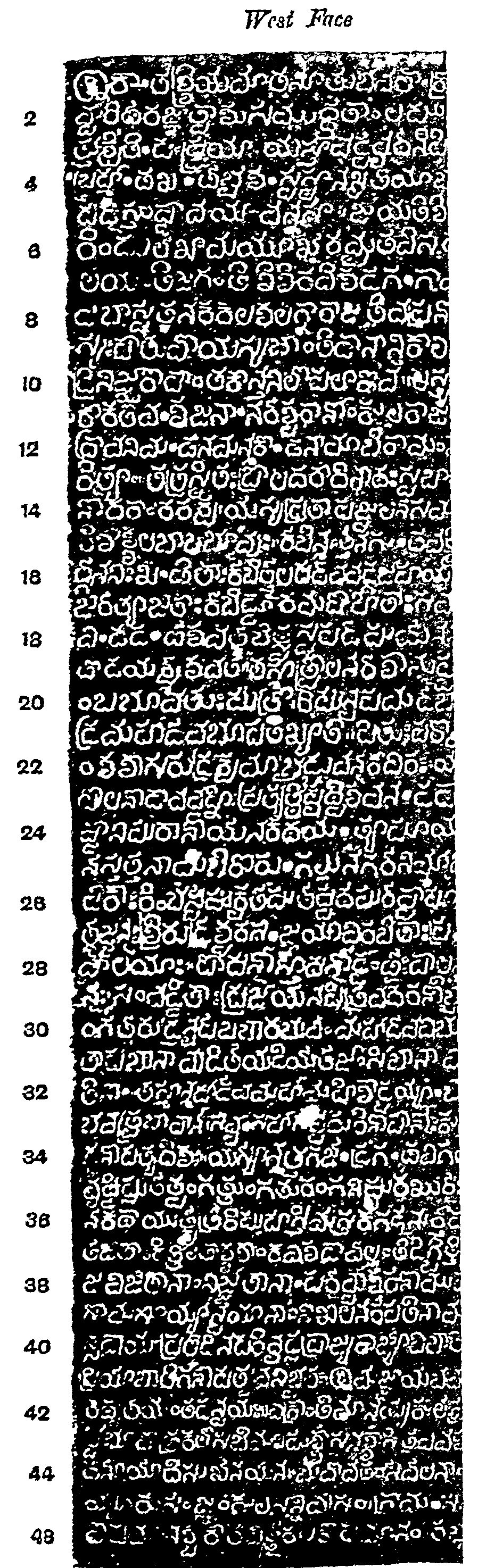
This plate shows the west face of a pillar in front of the Durgamba temple at Ganapesvaram, in Krishna district. Hultzsch states that the alphabet is Telugu, and that the language is Sanskrit verse followed by Telugu prose. He equates the date with Monday, 7 April 1231.
Plate published in E. Hultzsch, "Ganapesvaram inscription of the time of Ganapati, Saka-Samvat 1153", Epigraphia Indica Vol. III (1894-95), pp. 82-93. Plate: "West Face". · Public domain · This record in the database
Photograph of the stone
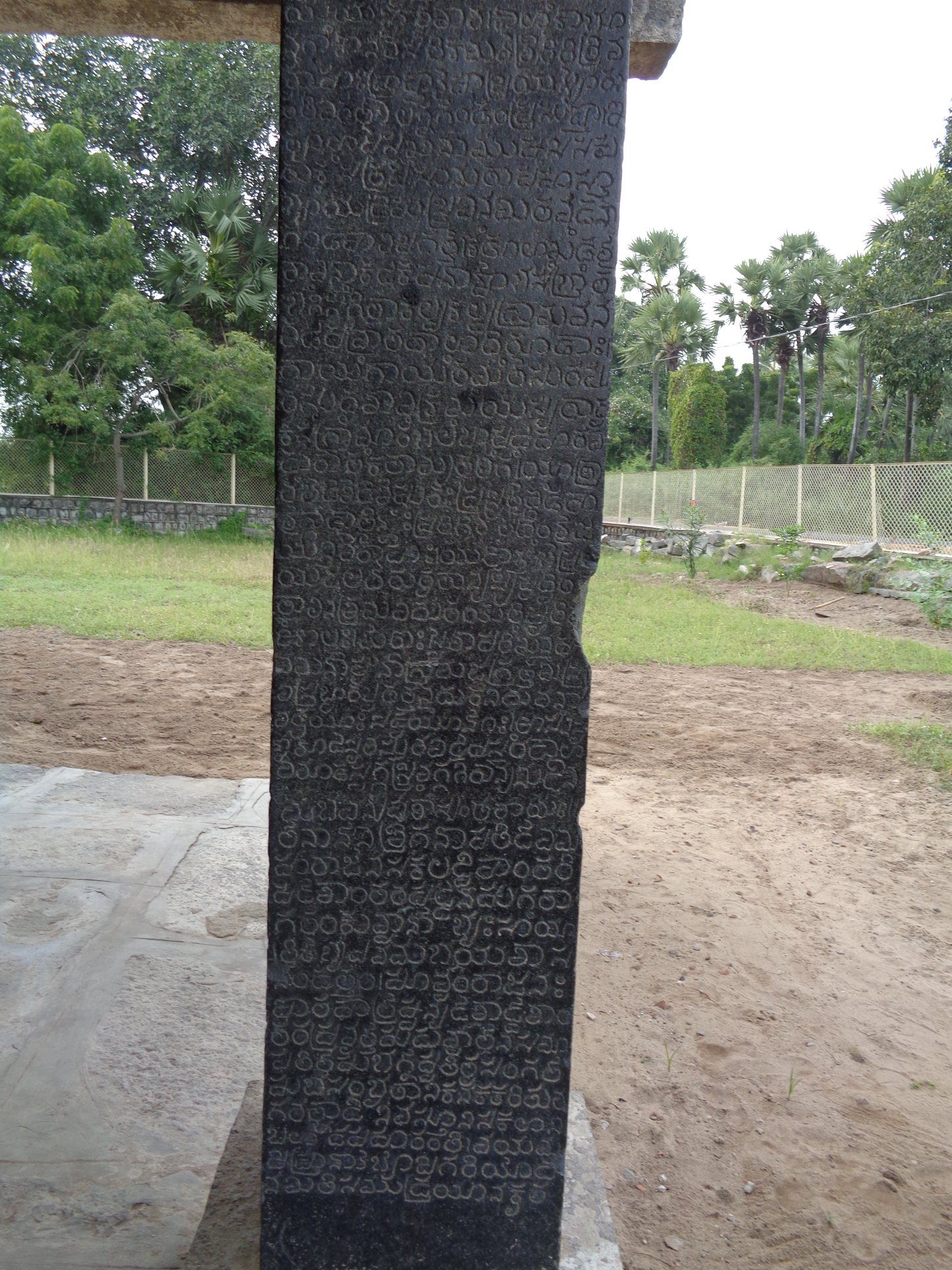
This pillar stands at the Veerabhadra Swamy temple in Motupalli, the old seaport. The Kakatiya king Ganapati issued the record engraved on it in 1244-45. Hultzsch edited the text in Epigraphia Indica XII.
Photo: WikiUserKCS, via Wikimedia Commons · CC BY-SA 4.0 · This record in the database

Epigraphia Telanganica, in four volumes of 2023, gives English translations and summaries of the Telangana inscriptions. The Government of Telangana allows free use for non-commercial reference. The volumes do not print the original Telugu or Sanskrit texts.
Epigraphia Telanganica 2023 · ET I General Introduction p. 7, copyright page
The Hyderabad Archaeological Series of the Nizam's government edited single records with plates. Number 3 (1919) covers the Ramappa and Uparpalli pillars. Number 6 (1925) covers the Kotagiri plates.
The Nizam's government also began A Corpus of Inscriptions in the Telingana Districts. P. Sreenivasachar edited Parts I and II in 1942 and Part III in 1956. M. Somasekhara Sarma prepared Part IV in his last years, and it appeared in 1973.
Sreenivasachar 1942Corpus III (1956)Corpus IV (1973)Parabrahma Sastry 1978 · pvs1972 pp. 7-8
Epigraphia Indica printed several major Kakatiya records. Volume III has Ganapesvaram, Volume VI has Chebrolu, Volume IX has the Padmakshi pillar, and Volume XII has Motupalli.
Epigraphia Indica IIIEpigraphia Indica VIEpigraphia Indica IXEpigraphia Indica XII · Record ii-ganapesvaram · Record ii-chebrolu · Record ii-anmakonda · Record ii-motupalli-bapatla
J. F. Fleet published the Thousand Pillar inscription in The Indian Antiquary, Volume XI, in 1882. Fleet worked from an ink impression supplied through the Hyderabad authorities.
Fleet 1882Epigraphia Telanganica 2023 · ET II p. 63 · Record ii-hanumakonda-3
South Indian Inscriptions, Volumes IV, V, VI and X, print many Kakatiya-period records from the coastal districts. Parabrahma Sastry calls these volumes of immense value. Volume X (1948) holds the Telugu records of the Madras Presidency.
Parabrahma Sastry 1978SII X (1948) · pvs1972 p. 7
The Andhra Pradesh Department of Archaeology published district volumes for Warangal, Karimnagar and Nalgonda. Parabrahma Sastry reports that the Warangal and Karimnagar volumes of 1974 hold about 225 inscriptions.
Parabrahma Sastry 1978 · pvs1972 p. 8
S. S. Ramachandra Murthy gathered 367 Kakatiya inscriptions, with text and English translation, in one volume in 2011.
Parabrahma Sastry's Kakatiya Sasana Sahityam, in Telugu, reads the inscriptions as literature. The book names many composers and quotes their verses.
The public-domain volumes are free on the Internet Archive. These include HAS 3, HAS 6, the Corpus Parts I to III, Epigraphia Indica and The Indian Antiquary. The sources page of this site gives each link.
Barnett 1919Kotagiri plates 1925Sreenivasachar 1942Corpus III (1956)Epigraphia Indica IIIFleet 1882