Aggalayya Gutta
Aggalayya Gutta is a granite hill at Hanamakonda, opposite the Padmakshi hill. Large standing Jain Tirthankaras are carved on its rock faces. No inscription dates them, and the link with the physician Aggalayya rests on tradition.
- Period
- Undated. Writers date the carvings to the 9th to 11th century on grounds of style, before the Kakatiyas ruled in their own right
- Materials
- Reliefs carved on the granite of the hill
- Location
- 18.0002° N, 79.5706° E
Source of the position: Wikidata Q141309100, which agrees within 50 m with the GPS of the Commons photographs
- Condition
- Developed for visitors and in Jain worship. The paint has been removed from the large statue. The left hand of the large statue and some neighbouring reliefs show modern repair or new carving.
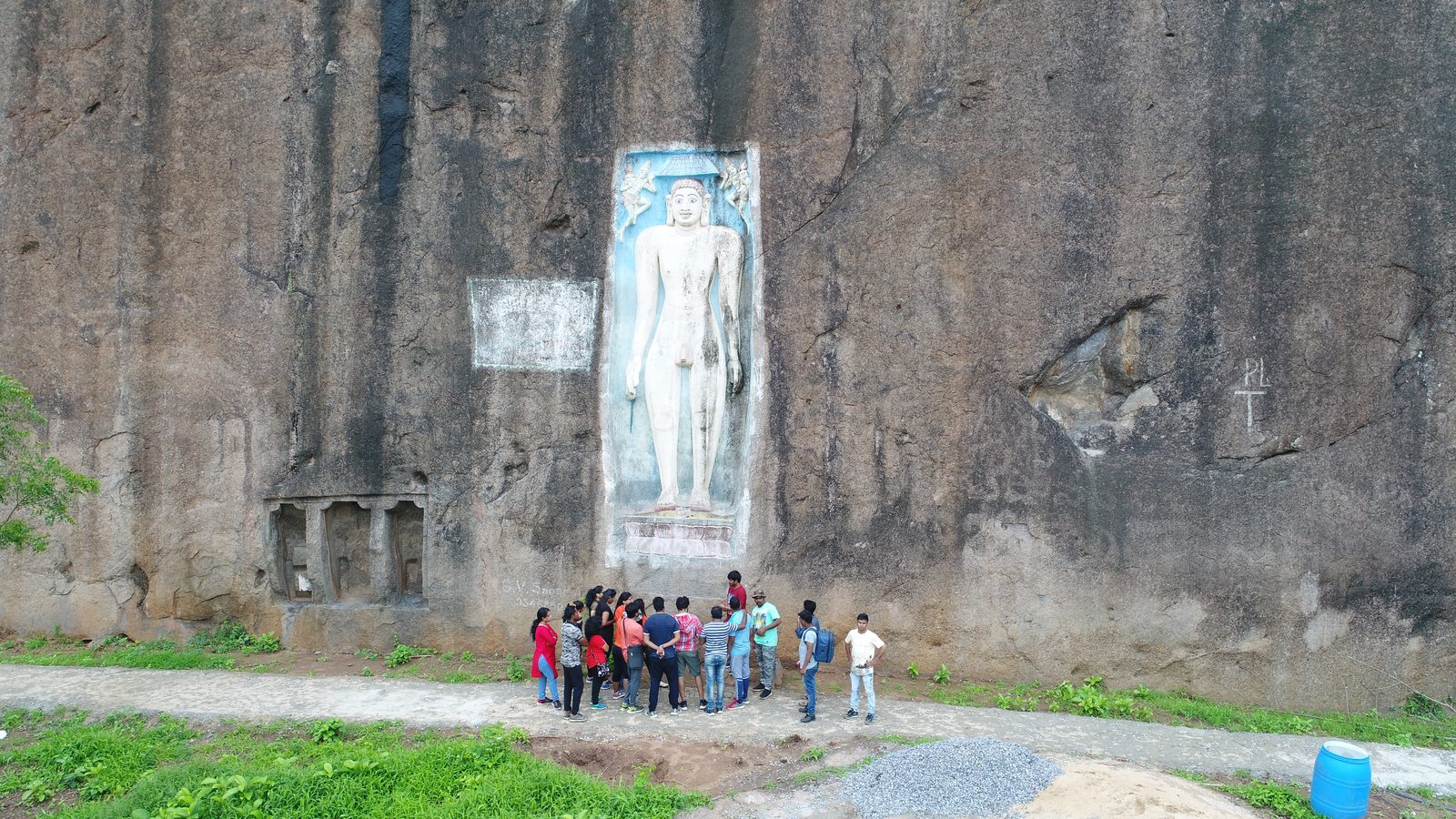
A large standing Jain Tirthankara is carved in a sunken panel on the sheer face of the hill. The visitors at its foot show the scale of the statue. In this photograph of 2018, the statue is painted white on a blue ground.

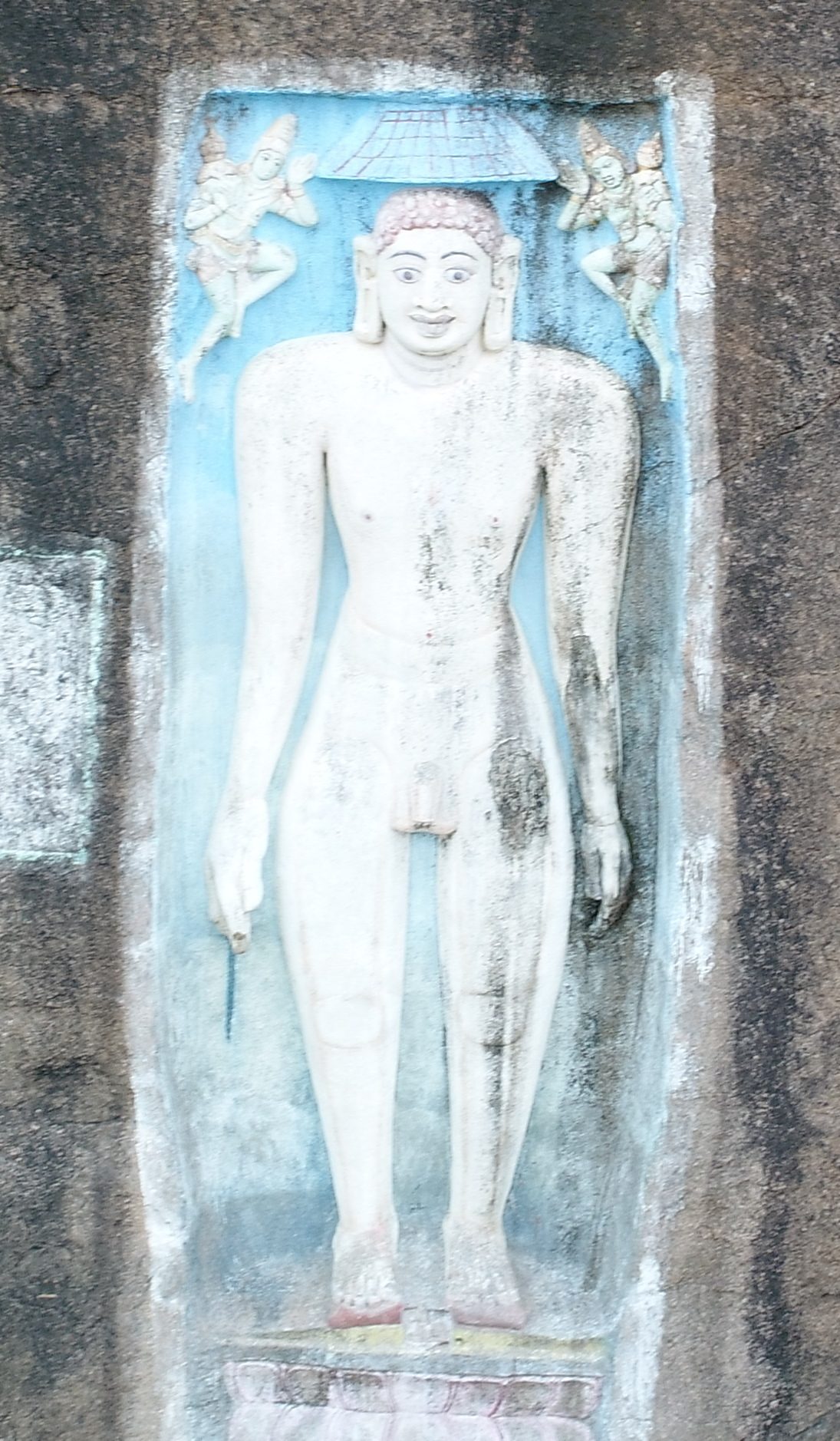
The Tirthankara stands upright with his arms straight at his sides. This posture is called standing meditation (kayotsarga). A parasol is carved above his head, and flying attendants appear in the upper corners.
.jpg)
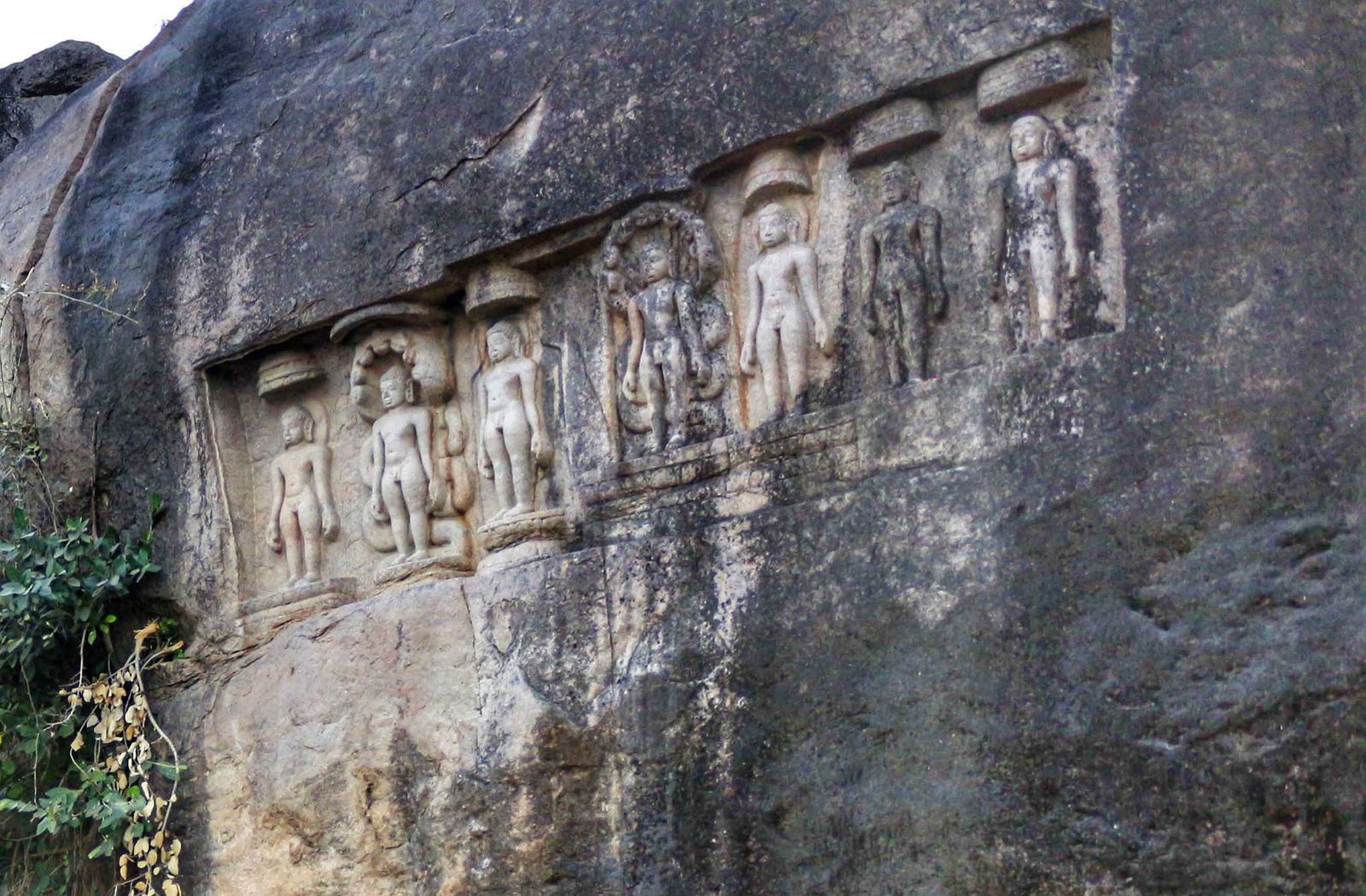
Seven standing Tirthankaras are carved in a row of niches on a boulder of the hill. Two of the sculptures stand in front of the coils of a snake, and its hood rises over their heads.

Detail
- A census volume of the early 1960s describes a rock-cut Jain Tirthankara on the slope of the hill next to the Thousand Pillar Temple. This is probably the large statue on Aggalayya Gutta.Census 1961, Fairs and Festivals: Warangal
- The largest statue is a standing Tirthankara in a sunken panel on a sheer rock face that looks north. News reports give its height as 30 or 35 feet.Telangana Today, July 2021Deccan Chronicle 2018Telugu WikipediaTelangana360, 2024
- Writers do not agree about whom the statue represents. News reports name him Shantinatha, the sixteenth Tirthankara. One Commons description names him Sambhavanatha, the third Tirthankara, from a horse emblem at his feet.Telangana Today, July 2021Wikimedia Commons descriptionsTelangana360, 2024
- A second standing statue, about 13 feet high, is Parsvanatha. A snake with seven hoods rises over his head.Telangana Today, July 2021Wikimedia Commons descriptions
- A row of seven smaller standing Tirthankaras is carved in niches on a boulder of the hill. Two of them stand in front of the coils of a snake.Wikimedia Commons descriptionsTelugu Wikipedia
- In 2018 local people reported a Jain sculpture about four and a half feet high in a cave on the north-west side of the hill. The historian Sriramoju Haragopal identified it as Mahavira and dated it to the ninth century.Deccan Chronicle 2018
- No inscription on the hill has been reported, and the published surveys of the Hyderabad Archaeological Department do not describe these carvings. Every date given for them rests on style.Nizam’s Archaeological Reports 1920–31ASI 1900Wikimedia Commons descriptions
- Gopalakrishna Murthy dates the Jain reliefs on the nearby Padmakshi hill to Rashtrakuta times on grounds of style. He does not discuss Aggalayya Gutta.Gopalakrishna Murthy 1964
- Aggalayya was a Jain royal physician of the Western Chalukya king Jayasimha II. A pillar inscription of 1034 at Saidapur, in Nalgonda district, praises his skill in surgery.Epigraphia Telanganica 2023Goli Penchala Prasad et al. 2020
- The same inscription records gifts to two Jain temples that Aggalayya founded, at Mucchanapalli and Ikkuriki. The king made him a mahasamanta and the headman of Mucchanapalli.Epigraphia Telanganica 2023Goli Penchala Prasad et al. 2020
- Records of 1069 to 1074 from Sirur and Singur, in Medak district, name a mahasamanta Aggalarasa, or Aggalayya, who was skilled in medicine. One record also praises his wife Vallikambe.Epigraphia Telanganica 2023
- None of these inscriptions mentions Hanamakonda. They describe a layman and an official, not a Jain monk.Epigraphia Telanganica 2023Goli Penchala Prasad et al. 2020
- Local tradition names the hill after Aggalayya, a Jain muni. Some recent writers call him a Jain teacher, and one says that a statue of him stands on the hill. No inscription supports these claims.Telugu WikipediaWikimedia Commons descriptions
- In 2021 a local enthusiast reported mortars cut into the rock and parts of a stone vessel for giving medicine. News reports took these as signs that Aggalayya taught medicine here. The mortars are undated.Telangana Today, February 2021
- Photographs of 2017 and 2018 show the large statue painted white on a blue ground. Photographs of 2024 and 2025 show the paint removed and the statue in a pale finish.Deccan Chronicle, February 2017Wikimedia Commons descriptionsVeludharan blog, 2025
- The Kakatiya Urban Development Authority developed the hill for visitors under the HRIDAY scheme from about 2017. During this work the Parsvanatha relief was recut in fresh stone.Deccan Chronicle 2018Wikimedia Commons descriptions
- A Commons description of 2017 records that the seated Jina sculpture below the large statue was unfinished. A blog of 2025 states that this sculpture was completed during the renovation.Wikimedia Commons descriptionsVeludharan blog, 2025
- In photographs of 2018 and later, the lower left forearm of the large statue shows a patch of a different colour, with a sharp joint at the wrist. In photographs of 2024 the hand below this joint looks newer than the arm.Wikimedia Commons descriptionsVeludharan blog, 2025
Also recorded as
- Aggalaya Gutta
- Aggalaiah Gutta
- Aggalayya
- Aggalaiah
- Agilaiah Gutta
- Eggalayya Gutta
- Aggulayya Gutta
- Jain Tirthankara Hill
- Jaina Tirthankara Gutta
- Jain Hills
Sources
- ASI 1900
- Census 1961, Fairs and Festivals: Warangal
- Wikimedia Commons descriptions
- Deccan Chronicle, February 2017
- Deccan Chronicle 2018
- Epigraphia Telanganica 2023
- Goli Penchala Prasad et al. 2020
- Nizam’s Archaeological Reports 1920–31
- Gopalakrishna Murthy 1964
- Telangana360, 2024
- Telugu Wikipedia
- Telangana Today, February 2021
- Telangana Today, July 2021
- Veludharan blog, 2025