Ursu Guttaఉర్సు గుట్ట
Ursu Gutta is a rocky hill beside the village of Ursu, on the western side of Warangal. Two Sanskrit poems by the poet Narasimha are cut on its rocks. The longer poem, of 62 verses, tells the love story of a Siddha couple.
- Period
- About the 13th century, by the style of the letters. Epigraphia Telanganica places the poems in the time of Rudrama Devi and Pratapa Rudra
- Materials
- Inscriptions cut on dressed faces of granite boulders
- Location
- 17.9642° N, 79.5819° EWarning: approximate
Source of the position: The hill as pinned by the author. The Wikidata point for Ursu village (Q134885825) lies within 20 m, and the geotags of the 2020 Commons photographs of the inscription lie about 180 m away
- Condition
- In the open on the hillside. In photographs of 2020 the letters are worn and hard to make out, and a painted mark has been added to the inscribed face.
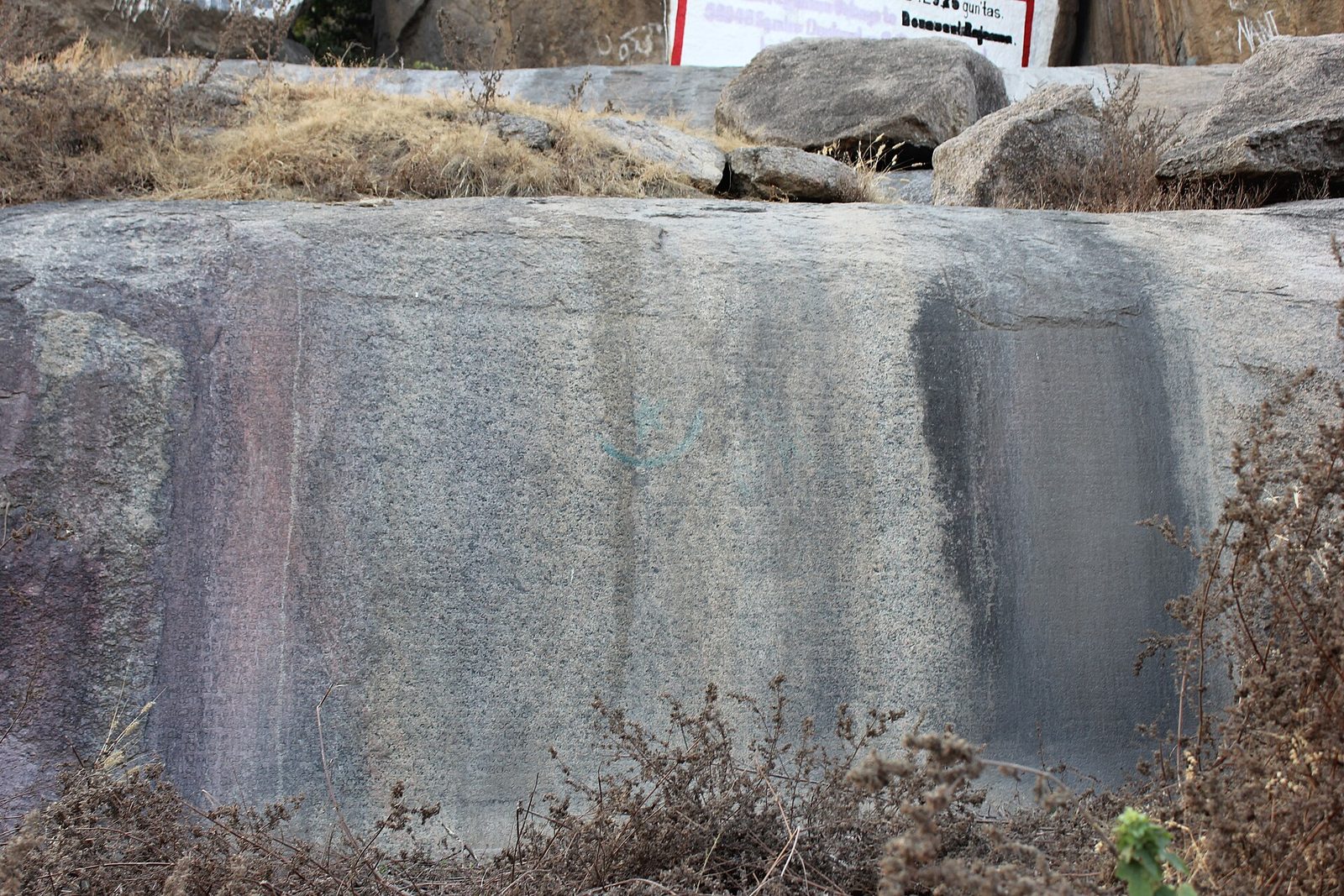
The dressed face of the boulder that carries the Siddhodvaha poem. Epigraphia Telanganica describes the surface as divided into three panels, all of them filled with writing. The letters are too worn to show at this distance. Photograph of 2020.
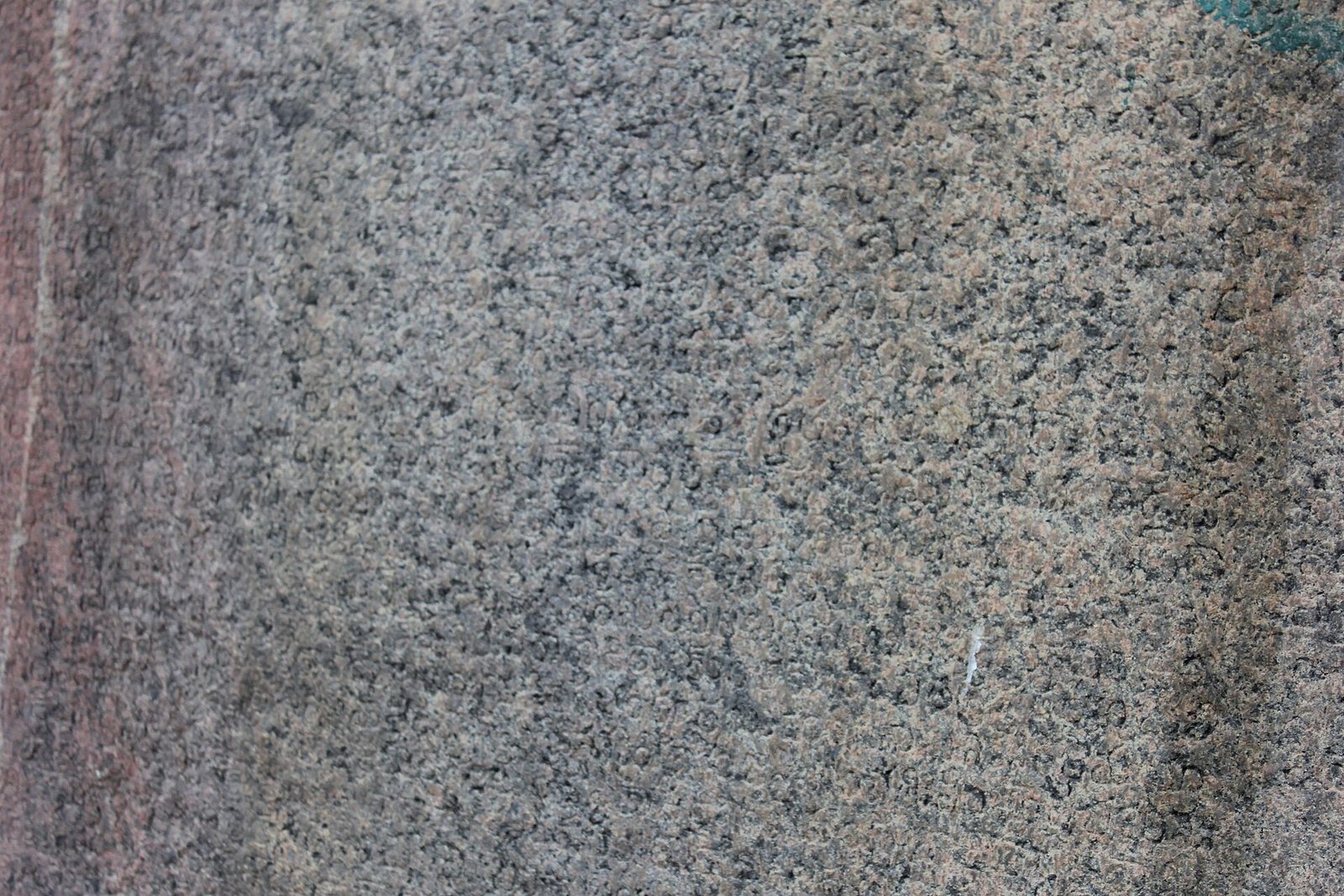
A close view of part of the poem. Rows of small rounded letters can be made out on the speckled granite. Photograph of 2020.
Detail
- The longer inscription is on a huge rock called Urusu-gutta, about a mile west of the village of Ursu. The inscribed boulder faces east. The 1958-59 report on Indian epigraphy says that the rock is well protected from the weather and from view.Annual Report on Indian Epigraphy 1958-59Epigraphia Telanganica 2023
- The surface of the rock was dressed smooth and divided into three panels of about equal width. The poem fills all three panels.Epigraphia Telanganica 2023
- The poem has 62 Sanskrit verses. The first 60 are in the Sardulavikridita metre and the last two in the Sragdhara metre.Epigraphia Telanganica 2023Annual Report on Indian Epigraphy 1958-59
- In the poem, a Siddha, a semi-divine being, wakes to find his beloved gone. He recalls how he first saw her at a music party of the Kinnaras on Mount Meru, and how they fell in love.Epigraphia Telanganica 2023
- Later in the poem, the hero climbs to the upper storey of the palace by a rope at night and is caught. The heroine's father, Kanakangada, puts him in prison. When the father learns that the hero is a Siddha of good family, he gives his daughter to him in a Vedic marriage. At the end a Yaksha reunites the couple.Epigraphia Telanganica 2023
- The inscription gives no title. Parabrahma Sastry edited the poem under the title Siddhodvaha, the wedding of the Siddha. Sastry notes that its opening verse imitates the first verse of Kalidasa's Meghaduta.Parabrahma Sastry 1975 (thesis)Epigraphia Telanganica 2023
- Epigraphia Telanganica describes the poem as written in Telugu script except for its first line, which is in Nagari. The editors suggest that the engraver began in Nagari and then changed to Telugu. The 1958-59 report describes the poem simply as in Telugu characters.Epigraphia Telanganica 2023Annual Report on Indian Epigraphy 1958-59
- A second inscription is on a rock in the valley behind the shrine of Ranganayakulu. It is in Nagari script, incomplete and much damaged. Its colophon names a work on yoga by Narasimha-maharshi. Here too the rock was dressed and marked into three panels, but only two panels were used.Epigraphia Telanganica 2023Annual Report on Indian Epigraphy 1958-59Parabrahma Sastry 1975 (thesis)
- The sources disagree on how the poet was related to Visvesvara, a royal teacher. The 1958-59 report reads the Nagari record as calling Narasimha the son of Visvesvara. A summary in Epigraphia Telanganica calls him the son of Visvesvara's daughter. Another summary in Epigraphia Telanganica names Visvesvara Pandita as the royal teacher of Rudrama Devi.Annual Report on Indian Epigraphy 1958-59Epigraphia Telanganica 2023
- The 1958-59 report suggests that this Visvesvara may be the same man as Visvesvara, the preceptor of Ganapati Deva.Annual Report on Indian Epigraphy 1958-59Epigraphia Telanganica 2023
- The poet Narasimha is also known from four short inscriptions in the same area. In them he claims a commentary on the Rigveda and a work called the Kakatiya-charita.Annual Report on Indian Epigraphy 1958-59Epigraphia Telanganica 2023
- The editors of Epigraphia Telanganica argue that the unfinished poem on Siddhesvara Gutta at Hanamakonda is also by Narasimha. They point out that its rock was dressed and divided into panels in the same way as at Ursu.Epigraphia Telanganica 2023
- The settlement report of 1893 lists Oorus and Karimabad among the suburbs of the town of Warangal. It records both villages as jagirs.Warangal Settlement Report 1893
- The census volume of the early 1960s on fairs and festivals says that Urus was also known as Rangasamudram and Ghajipur, and calls it a suburb of the city.Census 1961, Fairs and Festivals: Warangal
- The District Gazetteer of 1976 names Urus, with Karimabad, among the old centres of handloom and carpet weaving in the district.Warangal District Gazetteer 1976
- The same census volume describes the dargah of Hazrat Syed Shah Jalaluddin at Urus. In the story told there, the saint was born in Baghdad in Hijri 901, about 1495 CE. He did penance on the hillock of Urus and then settled in the village. The story says that he lived for 99 years.Census 1961, Fairs and Festivals: Warangal
- The District Gazetteer of 1976 lists the dargah of Hazrat Syed Shah Jalaluddin, with its four cupolas, among the places of interest in Warangal.Warangal District Gazetteer 1976
- Epigraphia Telanganica records a Persian epitaph of the 15th or 16th century at the Urusu Darga in Karimabad. It asks visitors to pray for Jalal Mudakkar Shirazi, who is buried there. No source says whether he is the saint of the census story.Epigraphia Telanganica 2023
Also recorded as
- Ursu Gutta
- Urusu Gutta
- Urusu-gutta
- Urus Gutta
- Ursu hill
- Urus
- Urusu
- Oorus
- Siddhodvaha inscription